- 0
- 1,178 word
University of Chicago professor Eman Abdelhadi’s controversial social media posts resurface following her half-brother Abdul El-Sayed’s Michigan Senate primary win.
Eman Abdelhadi’s Anti-U.S. Posts Resurface After Half-Brother Abdul El-Sayed’s Senate Primary Victory
Following Dr. Abdul El-Sayed’s recent victory in the 2026 Michigan Democratic Senate primary, social media posts from his half-sister, University of Chicago assistant professor Eman Abdelhadi, have drawn intense scrutiny. Conservative critics are highlighting Abdelhadi’s sharp critiques of the United States and her past legal troubles, raising questions about the potential impact on El-Sayed’s closely watched general election campaign.
The intersection of family ties, political campaigns, and academic freedom is under the spotlight as the 2026 Michigan Senate race intensifies. Dr. Abdul El-Sayed, a progressive epidemiologist, recently secured the Democratic nomination in a highly competitive primary. However, the political focus has partially shifted to his half-sister, Eman Abdelhadi, an assistant professor at the University of Chicago.
Abdelhadi’s past social media commentary, which frequently characterizes the United States as an empire rooted in settler colonialism and genocide, has been amplified by conservative commentators. This renewed attention brings her academic activism and past legal issues into the political arena, prompting debate over the boundaries of free speech and the potential liabilities of familial associations in high-stakes elections.
Resurfaced Posts and Rhetoric
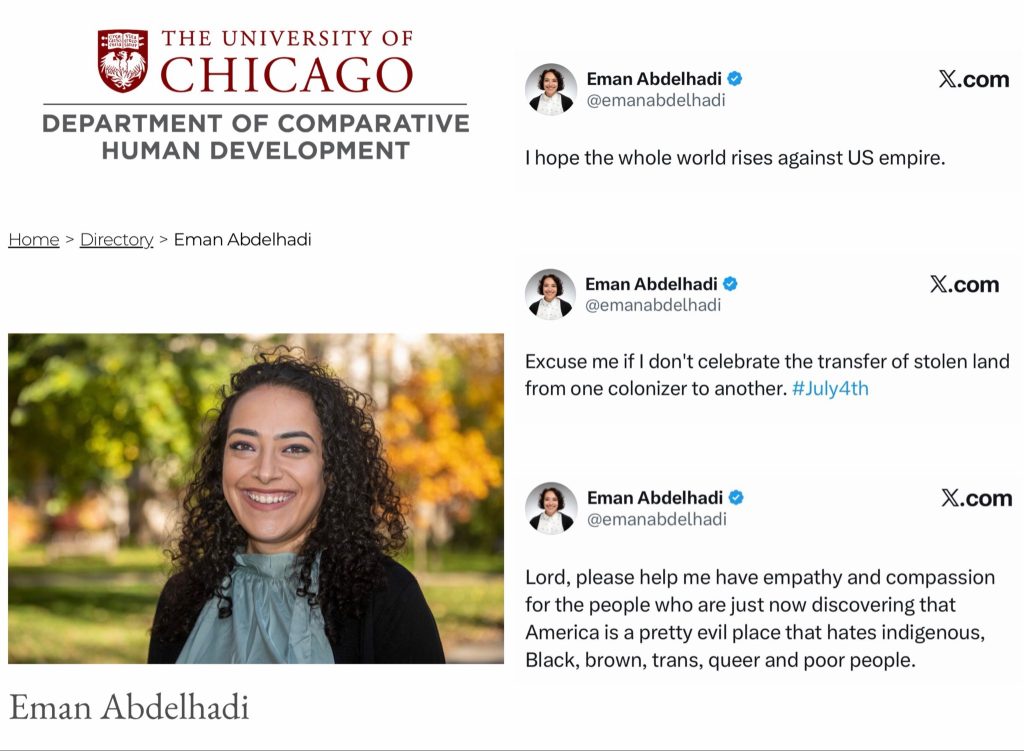
Eman Abdelhadi, who describes herself as a queer Muslim activist and community organizer, is known for her strong critiques of American history and institutions. As her half-brother secured his political victory, conservative accounts on X (formerly Twitter), such as End Wokeness and Libs of TikTok, began widely circulating her previous statements.
In one notable post, Abdelhadi commented on Thanksgiving, writing that it “would be a lovely holiday” if it were not “attached to genocide.” She further stated, “We can’t have nice things under settler colonialism. May all the empires fall.” Other posts from Abdelhadi frame foundational American holidays, like the Fourth of July, as markers of stolen land rather than celebrations of independence. She has consistently linked the history of the United States to racial domination and ongoing imperial practices, expressing a desire for global resistance against what she views as the U.S. empire.
The Political Implications for Abdul El-Sayed
The amplification of these posts coincides with Abdul El-Sayed’s narrow primary defeat of moderate Rep. Haley Stevens. El-Sayed ran on a progressive platform, advocating for Medicare for All, criticizing corporate influence in politics, and expressing opposition to certain U.S. foreign policies, including military aid to Israel.
Critics argue that Abdelhadi’s rhetoric reflects the broader ideological environment of El-Sayed’s progressive coalition. Conservative commentators are actively using her statements to urge voters to reject El-Sayed in the upcoming November general election, where he will face Republican former Rep. Mike Rogers.
Supporters of El-Sayed and advocates for academic freedom counter that a candidate should not be judged by the private political speech of a family member, emphasizing that faculty members have the right to express controversial views. El-Sayed has generally kept his half-sister out of his campaign materials, and there has been little public discussion of her activism from his camp, though Abdelhadi has previously expressed pride in his political endeavors.
Activism Beyond the Internet
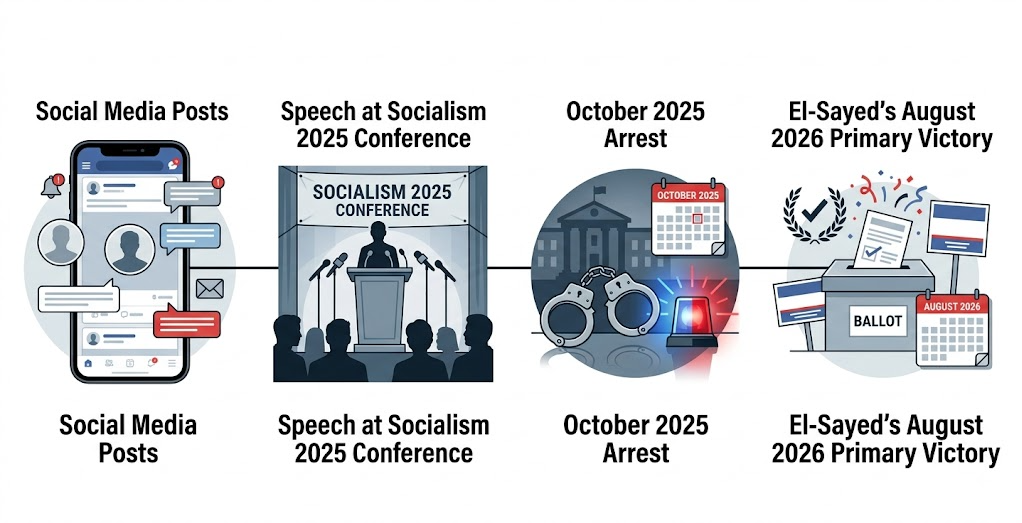
Abdelhadi’s activism has also manifested in public spaces and led to legal challenges. During the Socialism 2025 conference in Chicago, she delivered a speech in which she referred to her employer, the University of Chicago, as “evil” and a “colonial landlord.” According to recordings from the event, she explicitly stated, “F*** the University of Chicago, it’s evil,” explaining that she remained at the institution to leverage its resources for organizing purposes.
Following these comments, the university announced an investigation, reiterating its commitment to academic freedom while reminding faculty of their obligation to uphold professional standards. No disciplinary actions have been publicly announced, and Abdelhadi remains an active faculty member.
Legal Troubles in Broadview
In October 2025, Abdelhadi’s activism resulted in her arrest during a protest outside an Immigration and Customs Enforcement (ICE) processing facility in Broadview, Illinois. She faced significant legal charges, including two counts of aggravated battery to a government employee (a Class 3 felony) for allegedly spitting on an Illinois State Police trooper, in addition to misdemeanor counts of resisting or obstructing officers.
She was briefly detained before being released. While the University of Chicago condemned violence broadly, they declined to comment specifically on Abdelhadi’s arrest or her ongoing employment status.
Navigating Academic Freedom and Political Realities
This controversy highlights the ongoing tension between academic freedom and political accountability.
- Progressive Perspective: Many academics and activists argue that critical examinations of settler colonialism and imperialism are vital for a reckoning with historical injustices.
- Conservative Perspective: Critics contend that such rhetoric delegitimizes the United States and alienates voters who view foundational national holidays as unifying traditions.
- Institutional Challenge: Universities are increasingly caught in the middle, balancing the protection of faculty speech with the need to address conduct that may cross into legal jeopardy or cause significant disruption.
Future Developments
As the Michigan Senate race moves toward the November general election, the impact of Abdelhadi’s resurfaced comments remains uncertain. In a crucial battleground state where control of the U.S. Senate is fiercely contested, both campaigns will be closely monitoring voter sentiment. The rapid spread of these years-old posts underscores how quickly digital footprints can influence modern political narratives.
Frequently Asked Questions
1. Who is Eman Abdelhadi?
Eman Abdelhadi is an assistant professor in the Department of Comparative Human Development at the University of Chicago, identifying as a queer Muslim activist and community organizer.
2. How is Eman Abdelhadi related to Abdul El-Sayed?
She is the half-sister of Abdul El-Sayed, the progressive Democratic nominee for the U.S. Senate in Michigan.
3. What were the controversial social media posts about?
Abdelhadi’s posts criticized the United States as an empire built on settler colonialism and genocide, specifically targeting holidays like Thanksgiving and the Fourth of July as celebrations of stolen land.
4. Why was Eman Abdelhadi arrested in 2025?
She was arrested during an ICE protest in Broadview, Illinois, and charged with aggravated battery for allegedly spitting on a state trooper, along with resisting arrest.
5. How has the University of Chicago responded?
The university has stated a commitment to academic freedom but noted that faculty must maintain professional standards. They have not announced any public disciplinary action regarding her conference comments or her arrest.
6. Who is Abdul El-Sayed running against in the general election?
Abdul El-Sayed will face Republican former Rep. Mike Rogers in the November 2026 general election.
The resurfacing of Eman Abdelhadi’s controversial statements and past legal issues adds a complex layer to Abdul El-Sayed’s campaign for the Michigan Senate. As conservative critics use her activism to challenge the ideological underpinnings of El-Sayed’s progressive platform, the situation serves as a stark reminder of the intertwined nature of personal associations and political viability. With control of the Senate on the line, Michigan voters will ultimately decide how much weight to give these overlapping narratives of ideology, academic freedom, and institutional accountability.
- 2026 elections
- Abdul El-Sayed
- academic freedom
- Broadview arrest
- Democratic primary
- Eman Abdelhadi
- End Wokeness
- free speech
- Haley Stevens
- ICE protests
- Libs of TikTok
- Michigan Senate race
- Mike Rogers
- political controversy
- political liability
- progressive politics
- settler colonialism
- social media backlash
- University of Chicago
- US Politics
Author

admin@insiderglobal.news
Related Posts

California Passes AB 2624 Expanding Privacy for Immigration Providers
- 0
- 1,290 word
California legislature passes AB 2624, extending Safe at Home protections to immigration support workers facing threats. Learn details, penalties, and reactions. Read...
- AB 2624 explained
- address confidentiality update
- ban doxxing service providers
- Bonta privacy measure
- California bill enrolled
- California passes immigration privacy bill
- Capitol protest planned
- free speech vs privacy debate
- immigration services safety
- journalist concerns AB 2624
- new California law 2027
- online posting restrictions
- protect immigration workers
- Safe at Home expansion
- threats against aid workers
Byron Donalds Wins Florida GOP Governor Primary
- 0
- 1,034 word
Trump-backed Rep. Byron Donalds wins Florida GOP primary for governor with nearly 50% of the vote. He faces Democrat David Jolly in...
- Byron Donalds primary win
- DeSantis successor
- Donalds vs Jolly
- first Black Florida governor
- Florida election night
- Florida governor race 2026
- GOP primary results
- James Fishback results
- Jay Collins loss
- moderate Democrat Jolly
- November showdown
- quick Florida vote count
- Republican unity call
- Sunshine State politics
- Trump Florida endorsement

Trump Posts ‘TRUMP 2028’ AI Images on Truth Social
- 0
- 1,107 word
President Trump posted AI images including a “TRUMP 2028” hat on Truth Social, sparking debate over a possible 2028 run despite the...
- 2028 speculation heats up
- 22nd Amendment explained
- AI image with Washington
- critics dismiss trolling
- political future debate
- Polymarket Trump hint
- presidential term limits news
- supporters hail 2028 posts
- TRUMP 2028 Truth Social
- Trump horseback AI
- Trump posts 2028 hat
- Trump third term tease
- Trump We are going to win
- Truth Social AI spree

Todd Blanche AG Nomination Stalls Over DOJ Anti-Weaponization Fund
- 0
- 1,444 word
Todd Blanche’s attorney general nomination faces a roadblock as GOP senators demand written proof that the DOJ spiked a $1.8B fund. Read...
- acting AG
- anti-weaponization fund
- attorney general nomination
- Capitol Hill
- Chuck Grassley
- confirmation hearing
- DOJ
- Donald Trump
- government accountability
- IRS settlement
- January 6 riot
- John Cornyn
- Justice Department
- Pam Bondi
- Republican senators
- Senate Judiciary Committee
- slush fund
- Thom Tillis
- Todd Blanche
- US Politics
Stevens & El-Sayed Clash in Fiery Michigan Senate Primary Debate
- 0
- 1,559 word
Explore the fiery 2026 Michigan Senate primary debate between Haley Stevens and Abdul El-Sayed. Dive into their clashes over AIPAC, policy, and...
- Abdul El-Sayed
- AIPAC funding
- battleground states
- campaign finance
- Democratic primary
- Detroit news
- FOX 2 Detroit debate
- Gary Peters replacement
- Gretchen Whitmer
- Haley Stevens
- ICE reform
- John Fetterman ogre comment
- Medicare for All
- Michigan elections
- Michigan politics
- Michigan Senate primary debate
- Mike Rogers
- progressive Democrats
- Senate race 2026
- US Senate control