- 0
- 1,267 word
Elon Musk sets ambitious goal of 30+ Starship launches daily by 2030. Explore the leap from current flights, aviation comparison, and key challenges ahead.
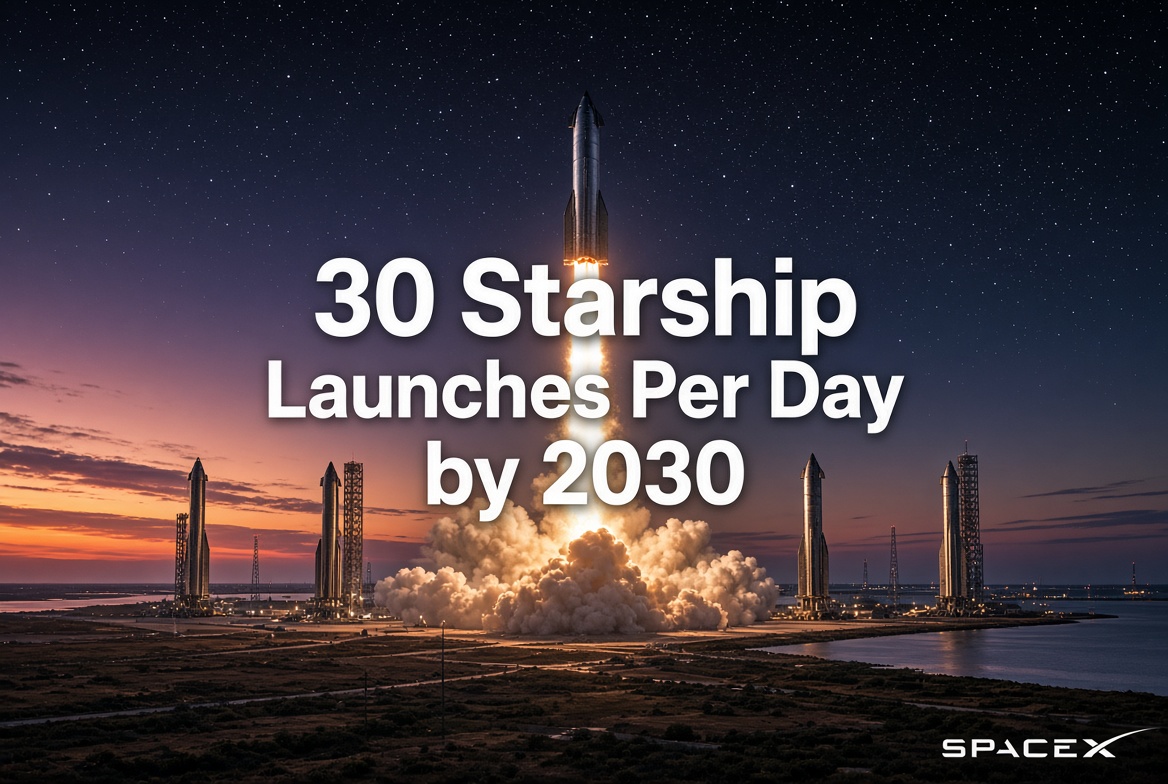
Elon Musk has outlined an ambitious target of more than 30 Starship launches per day by 2030. That cadence would equal roughly 10,000 flights annually and represents a massive increase from the handful of test flights completed since 2023. Musk compared the goal to commercial aviation, noting that even thousands of rocket launches would remain small beside today’s global air traffic.
SpaceX founder Elon Musk stated on X that the company is aiming for 30 or more Starship launches every day by the end of the decade. The figure works out to about 10,000 launches per year. He emphasized that such a rate would still be modest when measured against the roughly 100,000 commercial flights that take off worldwide each day.
The announcement underscores SpaceX’s long-term vision for turning Starship into a high-frequency transportation system rather than a occasional heavy-lift rocket. Achieving it will require major advances in reusability, ground infrastructure, propellant supply, and regulatory processes.
Current Starship Flight Record
Since the first integrated flight test in April 2023, Starship has completed roughly 13 full-stack launches through mid-2026. The program has recorded a mix of successes and setbacks. Early flights ended in explosions or incomplete missions. Later tests achieved key milestones including booster catches with the launch tower’s mechanical arms, successful reentries, payload simulator deployments, and progressive improvements in heat-shield performance.
These flights have occurred primarily from Starbase in South Texas. The limited number highlights the gap between today’s developmental cadence and the operational tempo Musk envisions. Each test has generated engineering data that SpaceX uses to refine the vehicle, the Raptor engines, and ground systems.
The Scale of the Ambition
Thirty launches per day averages more than one launch every hour around the clock. Sustaining that rate would demand a large fleet of Super Heavy boosters and Starship upper stages, rapid turnaround times measured in hours rather than weeks or months, and continuous propellant production. Musk has previously spoken about full reusability as the foundation for such frequency.
He placed the goal in context by referencing commercial aviation. Global airlines currently operate on the order of 100,000 flights daily. Even 10,000 annual Starship flights would remain a small fraction of that activity. The comparison illustrates both the opportunity and the infrastructure challenge: aviation required decades to develop airports, air traffic control, fuel networks, and maintenance systems that support high daily volumes.
Expanding Launch Capacity in Texas and Florida
SpaceX is actively expanding its physical footprint to support higher flight rates. At Starbase in Texas, multiple orbital launch pads are operational or under development, along with production facilities known as Starfactories and Gigabays. Additional infrastructure projects include pipelines and liquefaction systems intended to supply liquid methane and oxygen on site rather than relying solely on truck deliveries.
In Florida, construction continues at Kennedy Space Center’s Launch Complex 39A and at Space Launch Complex 37 at Cape Canaveral. Regulatory approvals already authorize dozens of Starship launches and landings per year from these sites. Combined with Texas capacity, the dual-coast approach is designed to allow simultaneous operations, reduce range conflicts, and provide geographic redundancy.
Observers note that reaching 30 daily launches would likely require more pads than currently announced, plus sea-based or additional land sites. Propellant logistics, pad refurbishment after each launch, and airspace coordination would become the primary constraints once the vehicles themselves achieve high reliability.
Opportunities and Public Reaction
Supporters of the vision point to transformative applications. High launch rates could enable rapid Earth-to-Earth passenger or cargo transport, with flights lasting under an hour between distant cities. They could also support continuous deployment of Starlink satellites, construction of orbital infrastructure, lunar logistics, and eventual Mars missions. Frequent flights would drive down costs through manufacturing scale and operational experience.
Online discussion following Musk’s statement reflected both enthusiasm and caution. Many expressed excitement about the possibility of routine space access. Others highlighted practical hurdles: environmental reviews, local community impacts near launch sites, the need for thousands of skilled workers, and the capital required to build and maintain a large vehicle fleet.
Technical and Regulatory Challenges
Reaching the target depends on several interlocking advances. Full and rapid reusability of both booster and ship remains essential. Heat-shield durability, engine life, and automated recovery systems must improve beyond current demonstration levels. Ground systems need the ability to inspect, refuel, and restack vehicles in hours. Propellant production must scale dramatically—each Starship flight consumes hundreds of thousands of gallons of liquid methane and oxygen.
Regulatory frameworks will also need to evolve. Current FAA licensing and environmental processes were designed for far lower launch rates. Airspace management, range safety, and noise or environmental mitigation would require new approaches if launches occur multiple times per hour. SpaceX continues to work with federal agencies on these issues while expanding its facilities.
Timeline and Path Forward
Musk’s statement frames 2030 as the target year for the high-cadence regime. Intermediate milestones will include increasing the annual flight rate year by year, demonstrating consistent booster and ship reuse, completing additional pads in Texas and Florida, and proving propellant transfer and other orbital operations.
Success would position Starship as a foundational transportation system rather than a specialized launch vehicle. Failure to scale the supporting infrastructure or achieve the necessary reliability would keep rates far lower. SpaceX’s history of iterative testing suggests the company will continue flying frequently while solving problems in parallel.
Frequently Asked Questions
What exactly did Elon Musk say about Starship launches? He stated that SpaceX is aiming for 30 or more Starship launches per day by 2030, equating to roughly 10,000 launches per year, and noted that this would still be small compared with daily commercial airplane flights.
How many Starship flights have occurred so far? Approximately 13 full-stack test flights have taken place since the first integrated attempt in April 2023, with a combination of successes and failures that advanced the vehicle’s design.
Why compare Starship to airplanes? Musk used the comparison to show that even a high rocket launch rate would remain modest next to the roughly 100,000 commercial flights that occur worldwide every day, underscoring the scale of existing aviation infrastructure.
Where is SpaceX building capacity for higher launch rates? The company is expanding facilities at Starbase in Texas and developing multiple Starship pads at Kennedy Space Center and Cape Canaveral in Florida.
What are the biggest obstacles to 30 daily launches? Key challenges include achieving rapid vehicle reusability, scaling propellant production and delivery, constructing and operating enough launch pads, and adapting regulatory and airspace systems.
Could Starship enable Earth-to-Earth travel? High launch cadence is a prerequisite for point-to-point transportation concepts that could connect distant cities in under an hour, though significant technical and regulatory work remains.
Is 10,000 annual launches realistic by 2030? It is an ambitious long-term target that depends on solving reusability, infrastructure, and operational challenges; progress will be measured through increasing flight rates in the intervening years.
Elon Musk’s goal of more than 30 Starship launches per day by 2030 sets a clear direction for SpaceX’s development priorities. The jump from a limited number of test flights to airline-like frequency would require breakthroughs in reusability, ground systems, and regulation. While the technical and logistical hurdles are substantial, the potential applications—from satellite deployment to rapid global transport—continue to drive interest. As SpaceX expands its Texas and Florida infrastructure and accumulates flight experience, the industry will watch closely to see how quickly the cadence can rise.
- 10000 Starship flights year
- challenges to daily rocket launches
- future of orbital transport
- high-cadence spaceflight
- Musk 30 Starship launches daily
- Musk airplane comparison
- next era of space access
- propellant for daily launches
- rapid Earth-to-Earth rockets
- SpaceX 2030 launch goal
- SpaceX pad construction
- SpaceX Texas Florida expansion
- Starship airline-like cadence
- Starship flight test record
- Starship reusability push
Author

admin@insiderglobal.news
Related Posts

Tom Homan Rejects Racial Profiling Claims by Angie Nixon
- 0
- 1,230 word
Border Czar Tom Homan dismisses Angie Nixon’s ICE racial profiling accusations as ridiculous. He stresses legal standards and equal enforcement. Read the...
- Angie Nixon slave catchers comment
- Border Czar equal opportunity deporter
- claims ICE will shoot citizens
- community trust vs safety
- Florida Senate immigration fight
- Fox News Homan interview
- Homan Fox News appearance
- Homan rejects profiling claims
- ICE racial profiling debate
- interior immigration operations
- multi-country deportations
- progressive vs enforcement views
- reasonable suspicion explained
- sanctuary cities ICE response
- Trump border enforcement

Einride Orders 500 Tesla Semis for North America Fleet
- 0
- 1,066 word
Swedish firm Einride will phase in 500 Tesla Semis over 24 months, tripling its fleet for Amazon and others. Explore the $125M+...
- California Georgia freight corridors
- capacity without ownership
- commercial EV trucking
- Einride buys 500 Tesla Semis
- Einride revenue growth
- Einride triples fleet
- electric trucks for Amazon
- largest Tesla Semi order
- phased electric truck rollout
- Saga AI fleet management
- sustainable trucking milestone
- Tesla Semi 500-mile range
- Tesla Semi cost savings
- Tesla Semi North America
- zero-emission freight expansion

Trump Honors 16-year-old Ryder Williams Lifeguard Who Saved Boy from Rough Surf
- 0
- 1,218 word
President Trump honored 16-year-old lifeguard Ryder Williams and the boy he rescued at the White House. Learn about the heroic Santa Cruz...
- boy saved from waves honored
- California teen bravery
- courage under waves
- everyday hero recognition
- firefighter dream realized
- Lincoln Bedroom tour
- Nathaniel Rai White House
- Oval Office rescue story
- presidential honor ceremony
- rough surf survival
- Ryder Williams Trump meeting
- Santa Cruz hero visit
- teen lifeguard White House
- Trump praises lifeguard
- viral beach rescue president
USS Abraham Lincoln Faces Shortages After Record 260-Day Deployment
- 0
- 1,243 word
Families report food, soap, and plumbing shortages on the USS Abraham Lincoln after 260 days at sea. Officials push back as the...
- 260 days at sea
- Abraham Lincoln shortages
- carrier crew conditions
- combat carrier life
- Cooper visits Lincoln
- families raise alarm
- George Washington relief
- Hegseth response
- long deployment toll
- moldy showers ship
- Navy food reports
- Navy logistics challenges
- sailor mental health
- supply chain strain
- veteran pushes back

Minnesota Poll Workers Explain Voter Vouching in Undercover Video
- 0
- 1,390 word
Undercover footage captures Minnesota poll workers explaining how one registered voter can vouch for up to eight others. See official response and...
- Cam Higby burqa polling place
- election day vouching explained
- election security debate 2026
- false oath felony
- hidden camera Minnesota
- how vouching actually works
- Minneapolis primary undercover
- Minnesota poll workers video
- O’Keefe exposes vouching
- rare use of vouching data
- reform after video release
- SAVE America Act push
- Secretary of State reacts
- voter vouching loophole claim
- you’re the ID clip

Marvel Reveals X-Men Cast for 2028 MCU Movie at D23
- 0
- 1,110 word
Marvel Studios revealed the X-Men cast at D23, led by Sadie Sink as Jean Grey. See the full lineup including Adam Driver...