- 0
- 1,293 word
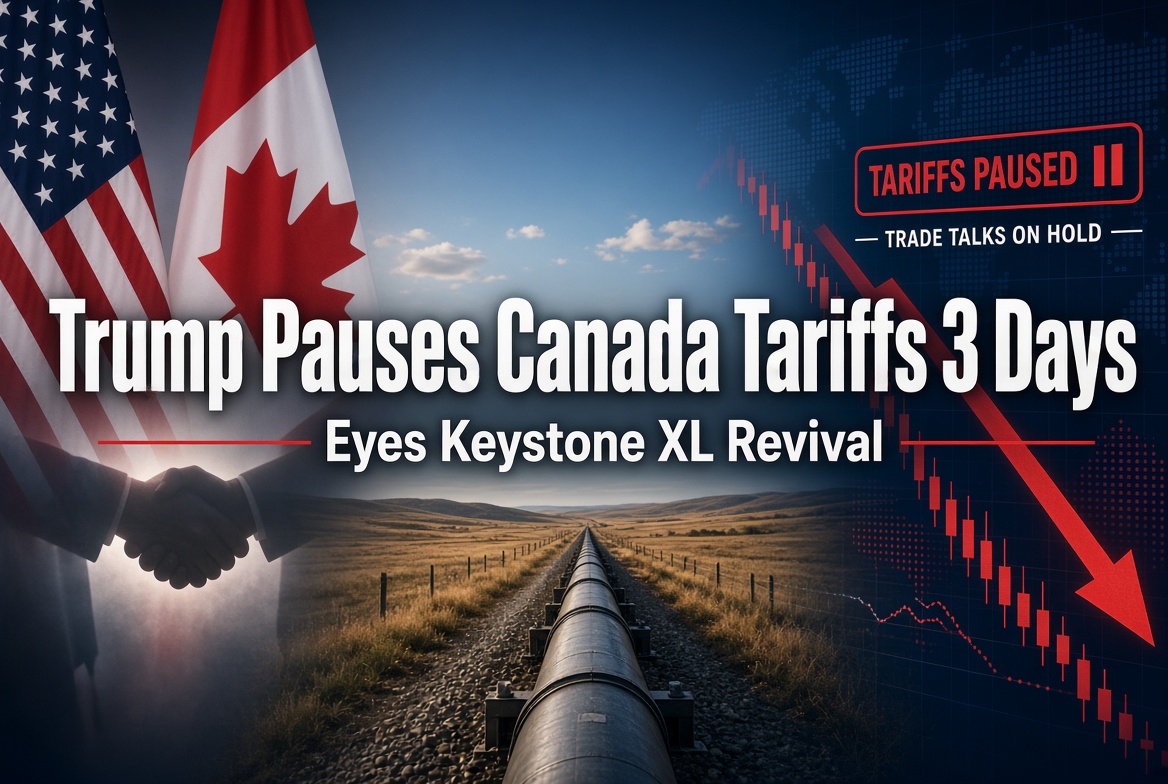
Trump pauses 50% Canada tariffs for three days after talks with PM Carney. Deal could revive Keystone XL pipeline. See full details and Canadian reactions now.
President Donald Trump announced a three-day pause on planned 50% tariffs against a wide range of Canadian goods just hours before they were set to take effect. The delay follows direct talks with Canadian Prime Minister Mark Carney and is tied to a pending trade agreement. Trump also signaled that the long-canceled Keystone XL Pipeline could return as part of broader cooperation.
The announcement came late on Tuesday, August 18, 2026, via Truth Social. Trump stated that the United States and Canada “have a DEAL” subject to the finalization of documents. The pause prevents the immediate imposition of duties that would have hit roughly $20 billion in Canadian imports, including products such as dairy, certain alcoholic beverages, furniture, and other goods.
The Tariff Pause and Immediate Context
The 50% tariffs had been scheduled to begin at 12:01 a.m. ET on August 19. Trump’s decision to delay them for three days provides negotiators additional time to complete paperwork. The Office of the U.S. Trade Representative described the emerging agreement as including comprehensive market access for American goods, economic security commitments, digital trade alignment, and protections for U.S. workers and markets while partnering with Canada.
Talks between the two leaders occurred twice this week. Carney characterized the discussions as “very delicate and intense.” Canadian officials confirmed substantial progress while noting that important work remains. The pause extends through the end of the day on Friday, August 21, according to Carney’s subsequent statement.
Key sticking points in the negotiations have included U.S. concerns over Canadian restrictions on American dairy, automobiles, and liquor sales. Several Canadian provinces had maintained bans or limits on U.S. alcohol products, while auto content rules and dairy market access remained contentious under the existing USMCA framework.
Keystone XL Pipeline in the Spotlight
In the same social media post, Trump highlighted the possible revival of the Keystone XL Pipeline. He wrote that the project, “long ago killed by Sleepy Joe Biden, may be awoken from the grave.” The pipeline was designed to transport approximately 830,000 barrels of Canadian crude oil per day from Alberta’s oil sands to U.S. refineries and markets.
Former President Joe Biden revoked the project’s cross-border permit in 2021, leading its owner, TC Energy, to cancel the remaining U.S. portion. The proposal had faced sustained opposition from environmental groups, Indigenous communities, and some landowners over climate and land-use concerns. Trump supported the pipeline during his first term and has repeatedly expressed interest in restarting it.
While Trump did not provide specific details linking the pipeline directly to the tariff pause, the mention positions energy cooperation as a potential element of the broader trade understanding. Canadian energy officials have previously indicated openness to discussing continental energy projects in the context of tariff relief.
Background on US-Canada Trade Tensions
Trade relations between the United States and Canada have faced repeated strain since early 2025. Canada was one of the few countries that initially retaliated against earlier U.S. tariff actions. Subsequent negotiations produced partial rollbacks, yet disputes over autos, dairy, and provincial alcohol policies persisted.
The threatened 50% duties would have applied broadly and without the exemptions that shielded many goods under USMCA. Analysts estimated the measures would affect about 5% of the total value of U.S. imports from Canada. Businesses on both sides of the border had warned of disruption to integrated supply chains that support billions of dollars in annual cross-border commerce.
Negotiators have engaged in intensive technical talks since July, when the tariff deadline was first set. Industry sources pointed to existing U.S. auto tariffs as one of the more difficult remaining issues.
Reactions in Canada and Across the Border
Responses in Canada have been mixed. Some observers expressed confidence in Carney’s handling of the high-stakes talks and welcomed the temporary relief for exporters. Others raised concerns about possible concessions on market access or energy policy that could face domestic political scrutiny.
Canadian businesses in affected sectors, including manufacturing and agriculture, viewed the three-day window as a chance to avoid immediate cost increases and supply disruptions. U.S. importers of Canadian goods similarly stood to benefit from the delay.
Environmental and Indigenous groups that previously opposed Keystone XL are expected to renew scrutiny if formal revival steps emerge. Energy producers in Alberta, by contrast, have long supported expanded pipeline capacity to U.S. markets.
Timeline of Recent Developments
- July 2026: Trump announces planned 50% tariffs on selected Canadian goods with an August 19 effective date.
- Ongoing July–August: Intensive bilateral negotiations and technical discussions.
- August 17–18: Trump and Carney hold two direct conversations.
- Late August 18: Trump announces three-day tariff pause and references possible Keystone XL revival.
- August 19–21: Window for finalizing documents under the paused tariffs.
Potential Impact and Next Steps
The short delay averts an immediate escalation that could have raised costs for consumers and manufacturers on both sides of the border. A completed agreement would likely address market access, regulatory alignment, and economic security provisions. Inclusion of energy infrastructure such as Keystone XL would carry longer-term implications for oil flows, investment, and environmental policy debates.
Officials from both countries emphasize that the current pause is temporary and depends on successful document finalization. Further details on the precise terms of the deal are expected in the coming days. Markets and industry groups will closely monitor whether the three-day period produces a durable resolution or requires additional extensions.
Cross-border trade remains a cornerstone of the North American economy. The current episode underscores both the depth of interdependence and the sensitivity of remaining barriers in autos, agriculture, and energy.
Frequently Asked Questions
Why did Trump pause the Canada tariffs? Trump stated that Canada and the United States have reached a deal subject to the finalization of documents, prompting a three-day delay of the 50% tariffs.
How long is the tariff pause? The pause lasts three days, covering the period that would have begun August 19 and extending through August 21 according to Canadian statements.
What is Keystone XL and why is it mentioned? Keystone XL is a proposed pipeline to carry Canadian crude oil to U.S. markets. Trump suggested it “may be awoken from the grave” after its cancellation under the Biden administration.
Which goods would the 50% tariffs have affected? The duties targeted a range of Canadian products including dairy, certain liquors, furniture, and other items totaling roughly $20 billion in annual trade value.
What issues were central to the talks with Mark Carney? Discussions focused on market access for U.S. autos, dairy products, and liquor sales, along with broader economic security and digital trade alignment.
Has Canada confirmed the deal? Prime Minister Mark Carney acknowledged substantial progress while noting that important work remains to be completed.
What happens after the three-day pause? Negotiators are expected to finalize documents. If successful, the tariffs would not take effect; otherwise, further decisions would be required.
President Trump’s decision to pause 50% tariffs on Canadian goods for three days creates breathing room for a potential trade agreement with Canada. The accompanying reference to reviving the Keystone XL Pipeline adds an energy dimension to the discussions. While details remain subject to final documentation, the move reflects ongoing efforts to manage one of the world’s largest bilateral trading relationships. Businesses, policymakers, and observers will watch closely as the short window for completion unfolds.
- $20 billion trade spared
- 50% tariff delay
- Canadian reaction mixed
- Carney Trump deal
- continental energy security
- dairy auto liquor talks
- energy deal hint
- final documents pending
- Keystone XL may return
- market access progress
- pipeline revival talk
- tariff deadline averted
- trade war pause
- Trump pauses Canada tariffs
- US-Canada trade breakthrough
Author

admin@insiderglobal.news
Related Posts

US Hits Record Oil and Gas Production Led by Permian
- 0
- 1,364 word
US crude oil hit a record 13.6 million barrels per day in 2025, with the Permian Basin topping 6.5 million. Natural gas...
- American energy workers
- crude oil all-time high
- EIA latest data
- energy independence debate
- Energy Secretary Wright statement
- future of US energy
- gas prices vs production
- LNG and domestic supply
- natural gas high 2026
- Permian 6.5 million barrels
- Permian drives output
- production efficiency gains
- shale boom continues
- US oil production record
- US tops world oil
US National Debt Tops $40 Trillion Milestone
- 0
- 1,167 word
US national debt hits $40.047 trillion, up from $39T in five months. Vance and Bessent outline growth plans amid rising interest costs....
- Bessent on 40 trillion
- budget deficit impact
- buybacks to start September
- debt grows faster than expected
- debt-to-GDP ratio
- fiscal challenges 2026
- how US reached 40 trillion
- interest costs rising
- markets react to debt
- national debt milestone
- publicly held debt 32 trillion
- Treasury debt report
- US debt hits 40 trillion
- Vance debt comments

Tesla Prepares Cybercab Robotaxi Launch in Austin This Month
- 0
- 1,103 word
Cybercab robotaxi Austin, purpose-built robotaxi, unsupervised autonomous vehicle, Giga Texas production, employee rides Tesla, Tesla Robotaxi service, two-seater Cybercab, no steering wheel...
- Austin Robotaxi expansion
- autonomous vehicle milestone
- Cybercab public road tests
- Cybercab vs Model Y
- employee rides start soon
- future of driverless taxis
- Giga Texas production ramps
- late August Cybercab
- no pedals no wheel vehicle
- purpose-built Cybercab arrives
- robotaxi debut this month
- Tesla Cybercab Austin launch
- Tesla first dedicated robotaxi
- Tesla ride-hailing update
- unsupervised Tesla taxi
Trump Asks Supreme Court to Approve White House Ballroom
- 0
- 1,223 word
Trump administration asks Supreme Court to resume $400 million White House ballroom construction, citing national security. Learn the legal battle and next...
- $400M ballroom fight
- appeals court blocks ballroom
- ballroom project timeline
- Congress vs executive power
- East Wing replacement lawsuit
- historic preservation challenge
- national security venue debate
- presidential bunker complex
- SCOTUS emergency request
- secure state visit facility
- Supreme Court White House case
- Trump East Wing demolition
- Trump Supreme Court ballroom
- White House construction halt
- White House security upgrade

SpaceX Completes $60B Acquisition of AI Coding Platform Cursor
- 0
- 1,210 word
SpaceX finalizes its $60 billion all-stock acquisition of Cursor, accelerating Grok development with new coding tools. Discover the details and impact on...
- $60B AI deal closes
- AI agent teammates
- AI coding race intensifies
- biggest tech acquisition 2026
- Cursor developer tools
- Cursor joins SpaceX
- enterprise AI expansion
- future of coding assistants
- Grok 4.6 progress
- Grok Bot launch momentum
- Grok coding boost
- Musk welcomes Cursor team
- SpaceX buys Cursor
- SpaceX compute advantage
- SpaceX stock conversion details

Lawrence Mayor Brian DePeña Arrested for $1.5M COVID Loan Fraud
- 0
- 1,245 word
Lawrence Mayor Brian DePeña was arrested by the FBI on wire fraud and money laundering charges over alleged misuse of $1.5M in...