- 0
- 1,103 word
Cybercab robotaxi Austin, purpose-built robotaxi, unsupervised autonomous vehicle, Giga Texas production, employee rides Tesla, Tesla Robotaxi service, two-seater Cybercab, no steering wheel vehicle, autonomous ride-hailing, late August rollout, Full Self-Driving, Tesla Austin deployment, first dedicated robotaxi, city street tests
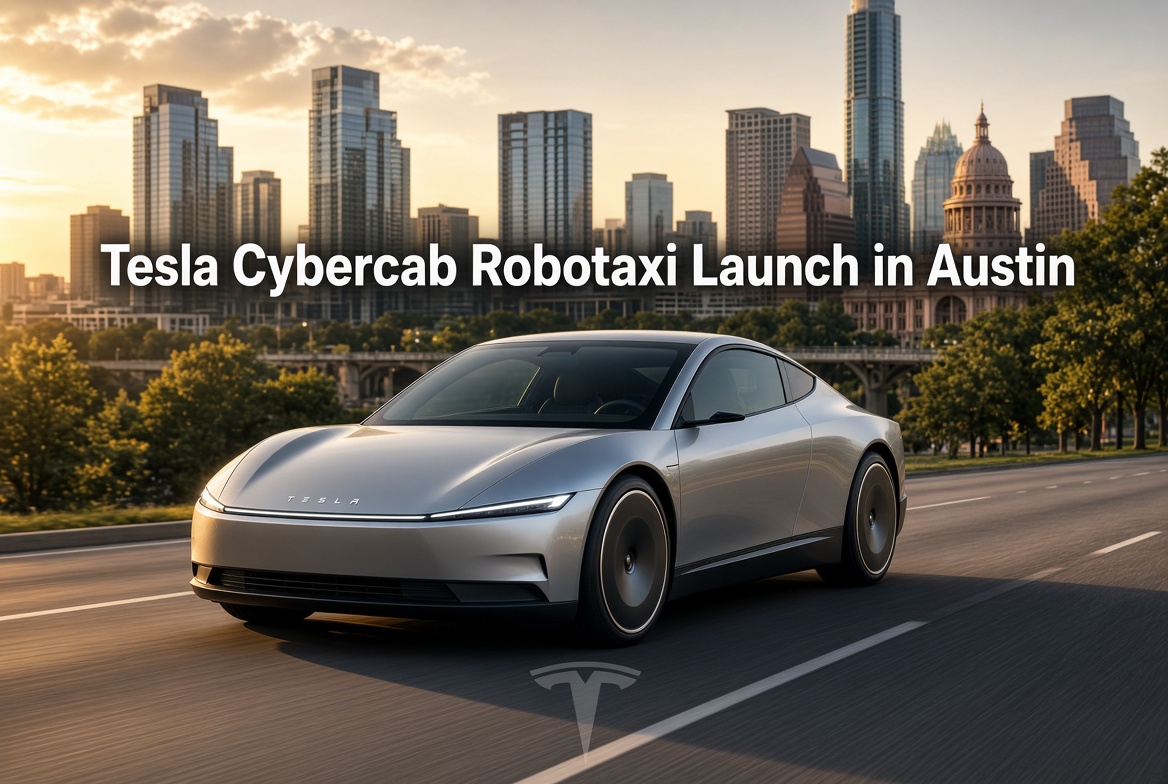
Tesla is preparing to introduce its purpose-built Cybercab robotaxi to the public in Austin as soon as late August. The company will start with rides for employees on public roads to gather data before expanding access through its existing Robotaxi service. Designed exclusively for unsupervised autonomous operation, the two-seater vehicle has completed city street tests and is in active production at Giga Texas.
The move represents a significant step for Tesla’s autonomous ride-hailing ambitions. Unlike previous robotaxi operations that relied on modified Model Y vehicles, the Cybercab is Tesla’s first fully dedicated robotaxi platform. It features no steering wheel and no pedals, reflecting the company’s vision for vehicles built solely around Full Self-Driving technology
Planned Rollout Sequence in Austin
According to reports citing people familiar with the plans, Tesla has informed employees of the internal timeline. The company intends to begin by offering Cybercab rides to staff on public roads in Austin. A few days later, the vehicles are expected to join the broader Robotaxi fleet available to the public in the city.
Preparations have followed a familiar pattern used in earlier robotaxi expansions. Recent weeks included test driving, employee rides on private roads around the Austin campus, and training sessions with local first responders. Officials confirmed that emergency personnel received instruction on how to handle the vehicles if needed.
The late-August target remains an internal goal and could shift depending on final validation. Tesla has not issued an official public confirmation of the exact start date.
Vehicle Design and Production Progress
The Cybercab is a compact two-seater engineered from the ground up for autonomous operation. Its design eliminates traditional driver controls, emphasizing passenger comfort and efficiency for short urban trips. Production of customer-specification units began at Gigafactory Texas earlier this year, with the first production vehicles undergoing engineering tests on public roads starting in June.
By mid-2026, observers noted increasing numbers of finished Cybercabs staged at the Texas facility. Capacity figures shared in company materials indicated potential for high-volume output later in the year once the ramp fully matures. The vehicle has received necessary regulatory certifications, including an EPA Certificate of Conformity confirming key specifications such as its single front motor and estimated range.
City street testing of production versions has provided real-world data specific to the new chassis. Company executives have previously noted the importance of accumulating Cybercab-specific driving miles before scaling the fleet significantly.
Background on Tesla’s Robotaxi Service
Tesla launched its initial Robotaxi service in Austin in 2025 using supervised and later unsupervised Model Y vehicles. The service later expanded coverage across the Austin metropolitan area and into other Texas cities. Until now, the fleet has operated without the purpose-built Cybercab hardware.
The introduction of the dedicated vehicle marks a shift from adapting existing passenger cars to deploying purpose-designed robotaxis. Elon Musk and other executives have long described the Cybercab and the associated ride-hailing network as central to Tesla’s long-term growth and profitability strategy. The roughly two-year period from the vehicle’s public unveil to planned commercial deployment reflects an aggressive development pace.
Impact on Operations and the Industry
Integrating Cybercabs into the Austin service could improve operational efficiency. The specialized design may allow higher utilization rates and lower costs per mile compared with modified consumer vehicles. For passengers, the experience will center on a cabin optimized for short autonomous trips rather than traditional driving.
The launch also intensifies competition in the autonomous vehicle sector. Other companies continue expanding their own driverless fleets in various markets. Tesla’s approach of pairing in-house vehicle production with its Full Self-Driving software differentiates it from players that rely more heavily on partnerships or third-party platforms.
Local coordination with first responders and regulators has been part of the preparation process, underscoring the practical requirements of deploying vehicles without human drivers on public streets.
Timeline of Key Developments
- Early 2026: First production Cybercabs roll off the line at Giga Texas.
- May 2026: EPA certification secured for the production vehicle.
- June 2026: Engineering tests of production Cybercabs begin on public roads in Austin.
- July 2026: Employee rides start on private roads around the Austin campus.
- Recent weeks: First responder training completed.
- Late August 2026 (targeted): Employee rides on public roads followed by integration into the Robotaxi service.
Future Developments
If the initial Austin deployment proceeds smoothly, Tesla is expected to increase the number of Cybercabs in service as confidence in the vehicle-specific data grows. Production capacity at Giga Texas is positioned to support broader rollout once software and operational readiness align. Additional cities may follow based on performance in the Texas market.
The company continues to refine Full Self-Driving software in parallel with hardware deployment. Success with the Cybercab could accelerate Tesla’s timeline for unsupervised autonomy across larger fleets and additional markets.
Frequently Asked Questions
When is Tesla expected to launch the Cybercab in Austin? Internal plans target as soon as late August 2026, beginning with employee rides on public roads.
What makes the Cybercab different from previous Tesla robotaxis? It is a purpose-built two-seater designed exclusively for unsupervised autonomous operation, with no steering wheel or pedals.
How will the rollout begin? Tesla plans to offer rides first to employees on public roads, then incorporate the vehicles into its existing Austin Robotaxi service a few days later.
Where is the Cybercab produced? Active production is underway at Gigafactory Texas.
Has the Cybercab been tested on public roads? Yes. Production versions began engineering tests on Austin city streets in June 2026.
What preparatory steps has Tesla taken? These include private-road employee rides, public-road testing, and training with local first responders.
Is the late-August timeline confirmed? It is an internal target reported by people familiar with the plans and could adjust based on final preparations.
Tesla’s preparations to introduce the Cybercab robotaxi in Austin mark the transition from adapted passenger vehicles to a dedicated autonomous platform. Starting with controlled employee rides before wider service integration allows the company to gather chassis-specific data while maintaining operational caution. Production at Giga Texas and completed street testing position the vehicle for this next phase. As the targeted late-August window approaches, attention will focus on how smoothly the purpose-built robotaxi integrates into real-world ride-hailing and what that signals for the broader future of unsupervised autonomy.
- Austin Robotaxi expansion
- autonomous vehicle milestone
- Cybercab public road tests
- Cybercab vs Model Y
- employee rides start soon
- future of driverless taxis
- Giga Texas production ramps
- late August Cybercab
- no pedals no wheel vehicle
- purpose-built Cybercab arrives
- robotaxi debut this month
- Tesla Cybercab Austin launch
- Tesla first dedicated robotaxi
- Tesla ride-hailing update
- unsupervised Tesla taxi
Author

admin@insiderglobal.news
Related Posts

US Hits Record Oil and Gas Production Led by Permian
- 0
- 1,364 word
US crude oil hit a record 13.6 million barrels per day in 2025, with the Permian Basin topping 6.5 million. Natural gas...
- American energy workers
- crude oil all-time high
- EIA latest data
- energy independence debate
- Energy Secretary Wright statement
- future of US energy
- gas prices vs production
- LNG and domestic supply
- natural gas high 2026
- Permian 6.5 million barrels
- Permian drives output
- production efficiency gains
- shale boom continues
- US oil production record
- US tops world oil

US National Debt Tops $40 Trillion Milestone
- 0
- 1,167 word
US national debt hits $40.047 trillion, up from $39T in five months. Vance and Bessent outline growth plans amid rising interest costs....
- Bessent on 40 trillion
- budget deficit impact
- buybacks to start September
- debt grows faster than expected
- debt-to-GDP ratio
- fiscal challenges 2026
- how US reached 40 trillion
- interest costs rising
- markets react to debt
- national debt milestone
- publicly held debt 32 trillion
- Treasury debt report
- US debt hits 40 trillion
- Vance debt comments

Trump Pauses Canada Tariffs 3 Days, Eyes Keystone XL
- 0
- 1,293 word
Trump pauses 50% Canada tariffs for three days after talks with PM Carney. Deal could revive Keystone XL pipeline. See full details...
- $20 billion trade spared
- 50% tariff delay
- Canadian reaction mixed
- Carney Trump deal
- continental energy security
- dairy auto liquor talks
- energy deal hint
- final documents pending
- Keystone XL may return
- market access progress
- pipeline revival talk
- tariff deadline averted
- trade war pause
- Trump pauses Canada tariffs
- US-Canada trade breakthrough

Trump Asks Supreme Court to Approve White House Ballroom
- 0
- 1,223 word
Trump administration asks Supreme Court to resume $400 million White House ballroom construction, citing national security. Learn the legal battle and next...
- $400M ballroom fight
- appeals court blocks ballroom
- ballroom project timeline
- Congress vs executive power
- East Wing replacement lawsuit
- historic preservation challenge
- national security venue debate
- presidential bunker complex
- SCOTUS emergency request
- secure state visit facility
- Supreme Court White House case
- Trump East Wing demolition
- Trump Supreme Court ballroom
- White House construction halt
- White House security upgrade

SpaceX Completes $60B Acquisition of AI Coding Platform Cursor
- 0
- 1,210 word
SpaceX finalizes its $60 billion all-stock acquisition of Cursor, accelerating Grok development with new coding tools. Discover the details and impact on...
- $60B AI deal closes
- AI agent teammates
- AI coding race intensifies
- biggest tech acquisition 2026
- Cursor developer tools
- Cursor joins SpaceX
- enterprise AI expansion
- future of coding assistants
- Grok 4.6 progress
- Grok Bot launch momentum
- Grok coding boost
- Musk welcomes Cursor team
- SpaceX buys Cursor
- SpaceX compute advantage
- SpaceX stock conversion details
Lawrence Mayor Brian DePeña Arrested for $1.5M COVID Loan Fraud
- 0
- 1,245 word
Lawrence Mayor Brian DePeña was arrested by the FBI on wire fraud and money laundering charges over alleged misuse of $1.5M in...