- 0
- 1,223 word
Trump administration asks Supreme Court to resume $400 million White House ballroom construction, citing national security. Learn the legal battle and next steps.
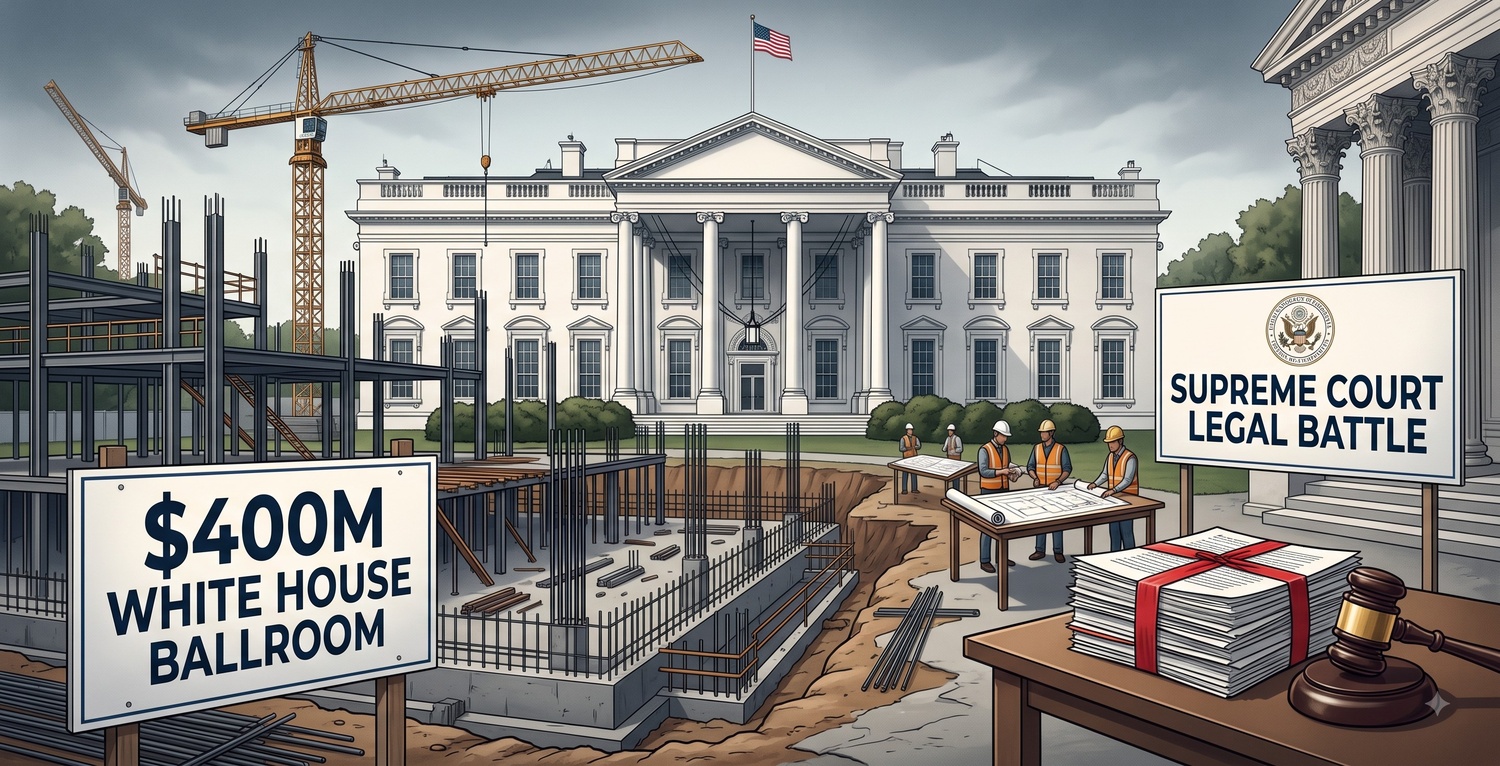
The Trump administration has asked the Supreme Court to allow construction of a $400 million White House ballroom to continue. Officials cite national security needs for a secure venue serving the president, family, staff, and foreign dignitaries. Lower courts blocked above-ground work, arguing the project requires congressional approval following a lawsuit by the National Trust for Historic Preservation.
On August 14, 2026, the Justice Department filed an emergency application with the Supreme Court. The request seeks to pause a recent appeals court order that would halt above-ground construction of the large new facility on the site of the former East Wing. Administration lawyers argue that stopping the project at this stage creates serious security risks and that the work is already well advanced.
The Legal Path to the Supreme Court
A federal district court earlier ruled that the president lacked unilateral authority to demolish and replace major sections of the White House without explicit approval from Congress. The U.S. Court of Appeals for the District of Columbia Circuit upheld that decision in a 2-1 ruling on August 7. The majority opinion stated that Congress holds constitutional control over federal property and that a massive redesign of the “People’s House” is not a matter for executive self-help.
The appeals court stayed its order for 14 days to give the administration time to seek higher review. Work was scheduled to stop around August 21 unless the Supreme Court intervenes. In its filing, the government described the project as approximately 65 percent complete, with a concrete-and-steel superstructure already rising and hundreds of workers operating on an accelerated schedule.
National Security Arguments
The administration frames the ballroom as an integrated secure facility rather than a purely ceremonial space. Court papers emphasize the need for a modern, protected venue capable of hosting large official events while incorporating underground enhancements for security and operational resilience. Officials point to ongoing threats against the president and the practical challenges of using temporary structures or existing limited rooms for high-level gatherings.
Secretary of State Marco Rubio has publicly noted that other nations provide more suitable venues for state functions. Joint Chiefs of Staff Chairman Gen. Dan Caine has been associated with broader discussions of military and security infrastructure requirements at the White House complex. The government argues that the combination of above-ground event space and subterranean features forms a single complex essential for protecting senior officials and supporting critical operations.
Critics of the national-security framing contend that the primary visible element remains a large entertainment hall and that ordinary legal processes should still apply to changes of this scale.
Background on the Project
President Trump announced plans for a major ballroom in 2025, describing it as a long-needed upgrade to accommodate state visits and large gatherings. The existing East Wing, originally constructed in 1902 and later modified, was demolished in late 2025 to clear the site. Current designs call for a structure of roughly 90,000 square feet—larger than the main Executive Mansion itself—capable of seating nearly 1,000 guests.
The project includes classical architectural elements intended to harmonize with the historic White House. Renderings released with recent court filings show exterior details such as prominent presidential seals. Funding for the above-ground ballroom has been described as coming largely from private donations, while underground security and military-related components involve public resources.
The National Trust for Historic Preservation filed suit in December 2025, arguing that the demolition and construction bypassed required review processes under historic preservation laws and that Congress must authorize such substantial alterations to a national landmark.
Timeline of Key Developments
- Late 2025: East Wing demolition begins; National Trust files lawsuit.
- Early to mid-2026: District court issues preliminary injunction against above-ground work; stays allow construction to continue during appeals.
- August 7, 2026: D.C. Circuit upholds the block in a divided decision and grants a short stay for Supreme Court review.
- August 14, 2026: Administration files emergency application with the Supreme Court.
Impact and Competing Views
Supporters of the project say it modernizes outdated facilities, improves security after documented threats, and ends reliance on temporary tents for major events. They view the court orders as improper interference with executive functions related to the safety of the president and the conduct of diplomacy.
Opponents, including the National Trust, insist that the White House belongs to the American people and that major structural changes require democratic accountability through Congress. They argue that allowing unilateral action sets a precedent that could affect future presidents and historic sites. Preservation advocates also raise concerns about scale, design compatibility, and the lack of full public review.
The case raises broader questions about the balance of power between the executive and legislative branches over federal property and the limits of presidential authority during a single term.
What Happens Next
The Supreme Court will decide whether to grant a stay that allows construction to resume while the full case proceeds, or to leave the lower-court order in place. Justices could act quickly given the approaching deadline for the halt. A decision either way is likely to shape both the physical future of the White House grounds and legal understandings of presidential power over the complex.
Construction of underground elements has faced fewer restrictions so far. If the high court permits the full project to continue, the administration aims for completion before the end of the current term. If blocked, the unfinished structure and legal questions could remain for Congress or a future administration to resolve.
Frequently Asked Questions
Why is the Trump administration going to the Supreme Court? Lower courts ruled that the $400 million ballroom project requires congressional approval. The administration seeks an emergency stay so construction can continue while the legal fight continues.
What is the estimated cost and size of the ballroom? The project is valued at approximately $400 million. The overall structure is planned at roughly 90,000 square feet and designed to host nearly 1,000 guests.
Who is challenging the construction? The National Trust for Historic Preservation filed the lawsuit, arguing that major changes to the White House need congressional authorization and proper historic review.
What national security claims are being made? Officials say the facility provides a secure venue for the president, family, staff, and foreign dignitaries, with integrated underground enhancements for protection and operations.
Has construction already started? Yes. The East Wing was demolished, and significant above-ground and underground work has advanced. The administration reports the project is about 65 percent complete.
What did the appeals court decide? In a 2-1 ruling, the D.C. Circuit held that Congress, not the executive branch alone, must authorize such a substantial redesign of the White House.
Could the Supreme Court allow work to resume quickly? Yes. The emergency application asks for immediate relief before the current stay expires around August 21.
The Supreme Court now faces a high-stakes request that blends questions of presidential authority, national security, historic preservation, and the physical future of the White House. The administration presents the ballroom and its underground components as an urgent, integrated security necessity. Lower courts have insisted that Congress must play a decisive role. How the justices respond will determine whether construction races ahead or pauses for further democratic and legal process. The outcome will influence both the landmark itself and broader understandings of executive power over the nation’s most iconic public building.
- $400M ballroom fight
- appeals court blocks ballroom
- ballroom project timeline
- Congress vs executive power
- East Wing replacement lawsuit
- historic preservation challenge
- national security venue debate
- presidential bunker complex
- SCOTUS emergency request
- secure state visit facility
- Supreme Court White House case
- Trump East Wing demolition
- Trump Supreme Court ballroom
- White House construction halt
- White House security upgrade
Author

admin@insiderglobal.news
Related Posts

US Hits Record Oil and Gas Production Led by Permian
- 0
- 1,364 word
US crude oil hit a record 13.6 million barrels per day in 2025, with the Permian Basin topping 6.5 million. Natural gas...
- American energy workers
- crude oil all-time high
- EIA latest data
- energy independence debate
- Energy Secretary Wright statement
- future of US energy
- gas prices vs production
- LNG and domestic supply
- natural gas high 2026
- Permian 6.5 million barrels
- Permian drives output
- production efficiency gains
- shale boom continues
- US oil production record
- US tops world oil

US National Debt Tops $40 Trillion Milestone
- 0
- 1,167 word
US national debt hits $40.047 trillion, up from $39T in five months. Vance and Bessent outline growth plans amid rising interest costs....
- Bessent on 40 trillion
- budget deficit impact
- buybacks to start September
- debt grows faster than expected
- debt-to-GDP ratio
- fiscal challenges 2026
- how US reached 40 trillion
- interest costs rising
- markets react to debt
- national debt milestone
- publicly held debt 32 trillion
- Treasury debt report
- US debt hits 40 trillion
- Vance debt comments

Trump Pauses Canada Tariffs 3 Days, Eyes Keystone XL
- 0
- 1,293 word
Trump pauses 50% Canada tariffs for three days after talks with PM Carney. Deal could revive Keystone XL pipeline. See full details...
- $20 billion trade spared
- 50% tariff delay
- Canadian reaction mixed
- Carney Trump deal
- continental energy security
- dairy auto liquor talks
- energy deal hint
- final documents pending
- Keystone XL may return
- market access progress
- pipeline revival talk
- tariff deadline averted
- trade war pause
- Trump pauses Canada tariffs
- US-Canada trade breakthrough

Tesla Prepares Cybercab Robotaxi Launch in Austin This Month
- 0
- 1,103 word
Cybercab robotaxi Austin, purpose-built robotaxi, unsupervised autonomous vehicle, Giga Texas production, employee rides Tesla, Tesla Robotaxi service, two-seater Cybercab, no steering wheel...
- Austin Robotaxi expansion
- autonomous vehicle milestone
- Cybercab public road tests
- Cybercab vs Model Y
- employee rides start soon
- future of driverless taxis
- Giga Texas production ramps
- late August Cybercab
- no pedals no wheel vehicle
- purpose-built Cybercab arrives
- robotaxi debut this month
- Tesla Cybercab Austin launch
- Tesla first dedicated robotaxi
- Tesla ride-hailing update
- unsupervised Tesla taxi

SpaceX Completes $60B Acquisition of AI Coding Platform Cursor
- 0
- 1,210 word
SpaceX finalizes its $60 billion all-stock acquisition of Cursor, accelerating Grok development with new coding tools. Discover the details and impact on...
- $60B AI deal closes
- AI agent teammates
- AI coding race intensifies
- biggest tech acquisition 2026
- Cursor developer tools
- Cursor joins SpaceX
- enterprise AI expansion
- future of coding assistants
- Grok 4.6 progress
- Grok Bot launch momentum
- Grok coding boost
- Musk welcomes Cursor team
- SpaceX buys Cursor
- SpaceX compute advantage
- SpaceX stock conversion details

Lawrence Mayor Brian DePeña Arrested for $1.5M COVID Loan Fraud
- 0
- 1,245 word
Lawrence Mayor Brian DePeña was arrested by the FBI on wire fraud and money laundering charges over alleged misuse of $1.5M in...