- 0
- 1,705 word
European Wildfires 2026: Bordeaux and Madrid Crisis Escalates
Massive European wildfires near Bordeaux and Madrid could burn for months. Discover the latest 2026 updates, evacuation numbers, and EU climate impacts.
Authorities Warn Massive European Wildfires Near Bordeaux and Madrid May Burn for Months
Western Europe is battling a historic environmental crisis as massive wildfires rage across France and Spain. Authorities have issued stark warnings that the blazes near Bordeaux and Madrid could smolder for months. Driven by extreme heat, prolonged drought, and erratic winds, firefighters are racing against time before a new heatwave intensifies the devastation.
The summer of 2026 has etched a grim milestone into the history of European climate events. Across southwestern France and central Spain, relentless wildfires are consuming hundreds of thousands of hectares of land, displacing hundreds of thousands of residents, and pushing international emergency response units to their absolute limits.
Officials across western Europe delivered a sobering assessment this week: the current infernos may not be fully extinguished for weeks, or potentially months. As a fresh heatwave threatens to push temperatures past 40°C (104°F) in the coming days, firefighters are adopting desperate measures to contain the rapidly advancing flames. The crisis highlights the growing frequency of extreme weather events, laying bare the vulnerability of the continent to a rapidly shifting global climate.
The Epicenter in France: Gironde Region Crisis
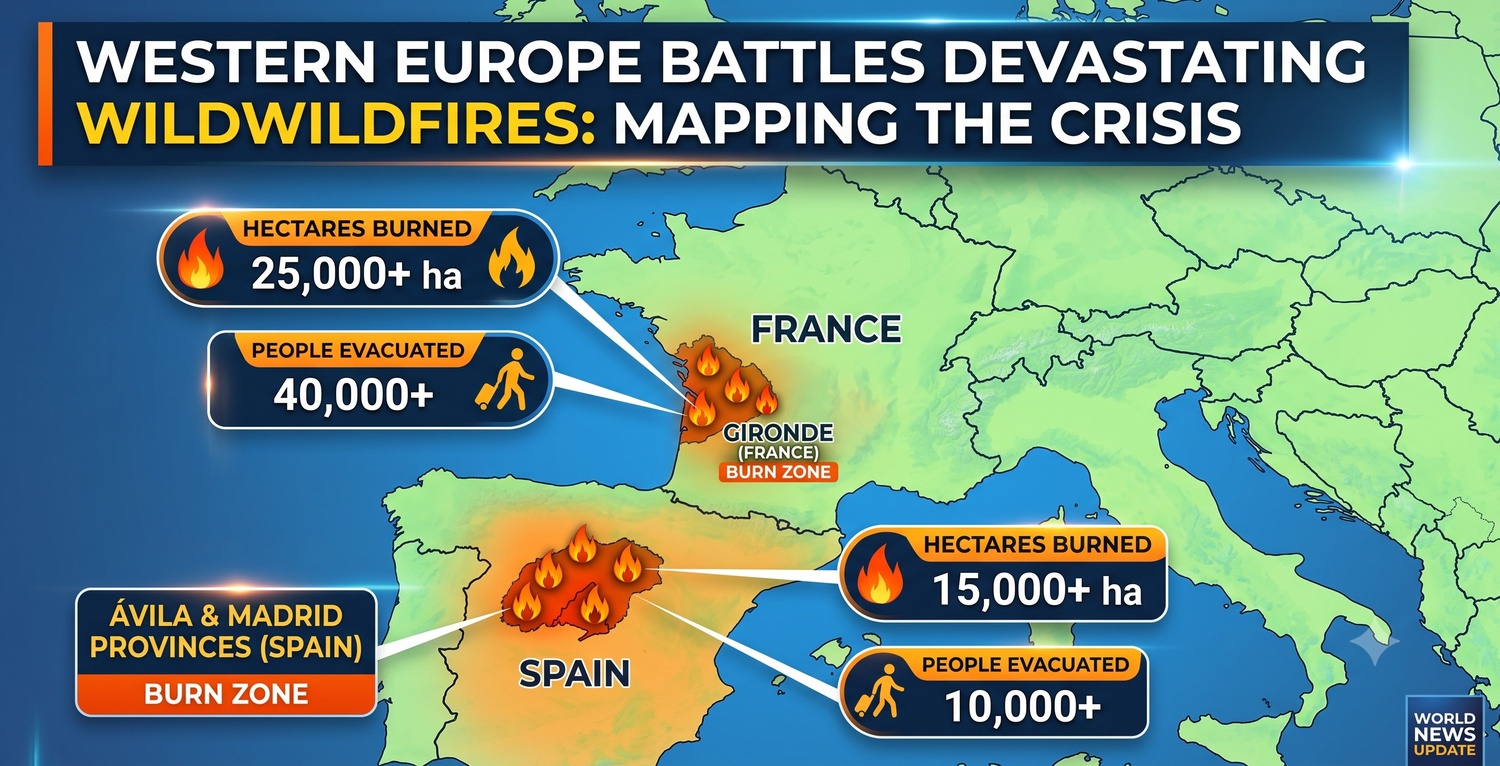
In France, the situation has escalated to unprecedented levels, particularly in the Gironde region. A colossal wildfire that ignited near the Atlantic coastline last week has aggressively expanded, scorching an area estimated to be four times the size of Paris.
The blaze has destroyed a confirmed 240 homes and encroached dangerously close to major population centers. At its peak, the fire line advanced to just 15 kilometers outside the Bordeaux metropolitan area. This proximity triggered one of the most extensive peacetime evacuations in modern French history. Authorities mandated the evacuation of roughly 220,000 individuals, a mix of local residents and summer tourists. Thousands have been forced to seek refuge in emergency shelters, including the sprawling Bordeaux exhibition center.
“Fire Clouds” and Unprecedented Meteorological Phenomena
French President Emmanuel Macron, who recently visited frontline responders in Bordeaux, characterized the unfolding disaster as the most severe challenge France has encountered since World War II. He urged the nation to remain resilient, stating that the country must unite to overcome the tragedy.
Local officials echoed this grave sentiment. Sophie Brocas, the regional prefect for Gironde, described the inferno as an anomaly that defies traditional firefighting tactics. According to Brocas, the fire is dictating its own rules, forcing emergency crews to constantly alter their strategies.
Most alarmingly, the intense heat has birthed rare meteorological anomalies known as pyrocumulonimbus formations, or “fire clouds.” These towering clouds generate their own localized weather systems, producing violent winds and dry lightning strikes that spark secondary fires miles away from the primary front. This phenomenon is highly unusual for the region and underscores the extreme intensity of the 2026 blazes.
Human Error and Tragic Losses
Prime Minister Sébastien Lecornu addressed the nation, confirming that 2026 officially stands as the worst wildfire year on French record. By late July, flames had already consumed over 116,000 hectares, with the peak of the summer season still looming.
While climate change has created the tinderbox conditions, the ignition sources are largely human. Lecornu pointed to carelessness—such as discarded cigarette butts, unattended barbecues, and negligent industrial work—as the primary catalysts. Law enforcement has also been active, questioning or detaining over 160 individuals suspected of deliberate arson since the beginning of July.
Tragically, the crisis has also claimed the life of a volunteer firefighter in the Bouches-du-Rhône region, whose vehicle veered off the road during emergency response operations earlier this week.
Spain’s Unprecedented Crisis: Madrid, Toledo, and Ávila
Simultaneously, the Iberian Peninsula is fighting a parallel catastrophe. In Spain, wildfires sweeping through the provinces of Madrid, Toledo, and Ávila have triggered the evacuation of more than 63,000 citizens.
The scope of the destruction is staggering. In Ávila alone, a single blaze has scorched approximately 50,000 hectares, cementing its status as the largest singular wildfire ever recorded in Spanish history. When combined with other fronts northwest of the capital, the charred landscape spans roughly 70,000 hectares.
Sixth-Generation Wildfires and Hidden Hazards
Spanish Prime Minister Pedro Sánchez addressed the ongoing disaster, framing it as the harshest manifestation of the global climate emergency. He cautioned that Europe has entered the era of “sixth-generation wildfires”—megafires that burn with such ferocity that they alter the local atmosphere and become virtually unstoppable by conventional firefighting methods.
Interior Minister Fernando Grande-Marlaska emphasized that the early days of this week were critical. Firefighters are in a desperate sprint to establish containment lines before a forecasted heatwave blankets the region, threatening to push temperatures above 40°C.
Complicating efforts in Spain’s eastern Castellón province is a deadly historical hazard: unexploded ordnance from the Spanish Civil War. As the extreme heat of the wildfires sweeps over these long-buried munitions, they are detonating, posing a lethal risk to the firefighters navigating the terrain.
International Response and the European Union’s Warning
The scale of the disaster has prompted a massive international response coordinated by the European Union. However, European Commission officials have painted a grim picture for the remainder of the year.
According to EU representatives, the 2026 wildfire season—which began abnormally early in April—could drag on into early November. Hadja Lahbib, the EU Crisis Response Commissioner, warned that the total ecological and infrastructural damage is expected to shatter all previous records. She candidly admitted that the continent currently lacks the adequate preparedness required to combat the accelerating consequences of climate change.
In response to the immediate threat, the EU has activated its strategic reserve. A fleet of 11 specialized firefighting aircraft has been deployed to assist French forces. Furthermore, an international coalition of emergency crews and aircraft from Turkey, Italy, Greece, Portugal, Switzerland, and the Czech Republic have mobilized to assist both France and Spain.
The Ripple Effects: Air Quality, Economy, and Vineyards
Beyond the immediate threat of encroaching flames, the fires are severely degrading the quality of life across western Europe. In Bordeaux, atmospheric particulate levels surged to six times the safe limits established by the World Health Organization (WHO).
Residents report a suffocating blanket of smoke and ash penetrating indoor spaces, rendering outdoor activities hazardous. This has led to self-evacuations, with many citizens fleeing the city even without official municipal mandates.
The regional economy, heavily reliant on summer tourism, has taken a significant hit. However, Bordeaux’s world-renowned wine industry has narrowly avoided a catastrophe for now. Experts indicate that because the grapes are still unripe at this stage of the summer, their thick skins make them less susceptible to “smoke taint.” Nevertheless, vintners remain on high alert as the fires show no signs of abating.
Background Information: The Climate Driver
The 2026 European wildfires are the direct result of a brutal combination of meteorological extremes. July temperatures in the affected areas are currently tracking nearly 6°C above the long-term historical averages. When coupled with a severe, prolonged winter and spring drought, the forests of France and Spain have been transformed into highly combustible fuel.
Timeline of the 2026 European Wildfire Crisis
- April 2026: Unseasonably warm temperatures spark early brush fires, signaling a premature start to the wildfire season.
- Early July 2026: A prolonged heatwave exacerbates drought conditions across Western Europe.
- Mid-July 2026: Major fires ignite in the Gironde region of France and the Ávila province of Spain.
- Late July 2026: Evacuations top 280,000 across both nations. The EU deploys its strategic firefighting reserve.
- July 28, 2026: Authorities issue warnings that the blazes may continue burning for months due to an impending secondary heatwave.
Impact on People, Business, and Government
- People: Over a quarter of a million citizens have been displaced, facing severe respiratory hazards and the loss of personal property.
- Business: Tourism has plummeted in peak season, and agricultural sectors are bracing for long-term soil degradation.
- Government: National budgets are being drained by emergency response logistics, forcing leaders to rapidly reassess climate adaptation policies and firefighting infrastructure.
Future Developments: Bracing for November
As August approaches, the immediate focus remains on preserving human life and critical infrastructure. However, forestry experts and climate scientists are already looking toward the autumn. With the dry season expected to stretch into November, governments must prepare for a prolonged state of emergency. The aftermath of these fires will likely spark aggressive legislative pushes for stricter land-management protocols and vastly expanded multinational firefighting fleets within the EU.
Frequently Asked Questions (FAQs)
1. Why are the European wildfires expected to last for months? Authorities state that extreme ongoing drought, persistent high temperatures, and vast areas of combustible forest make it impossible to fully extinguish the fires quickly. They expect the fires to smolder until heavy autumn rains arrive.
2. What are “sixth-generation wildfires”? Sixth-generation wildfires are highly intense, rapidly spreading megafires that generate their own weather systems, making them incredibly unpredictable and resistant to traditional firefighting techniques.
3. How many people have been evacuated in France and Spain? In 2026, roughly 220,000 people have been evacuated in the Gironde region of France, while over 63,000 have been displaced near Madrid, Spain.
4. Are the Bordeaux wine vineyards destroyed? As of late July, the vineyards have mostly escaped direct fire damage. Furthermore, because the grapes are currently unripe, they are highly resistant to smoke taint, though the situation remains precarious.
5. How is the European Union helping? The EU has activated its strategic reserve, sending 11 firefighting aircraft to France and coordinating the deployment of emergency teams from multiple nations, including Italy, Greece, and Switzerland.
6. What caused these massive fires? While extreme heat and drought created the ideal conditions, French authorities note that most fires were sparked by human carelessness, such as discarded cigarettes, with over 160 individuals investigated for suspected arson.
The 2026 European wildfires represent a terrifying new normal for the continent. As the flames outside Bordeaux and Madrid continue to carve paths of destruction, the resilience of emergency responders and local communities is being tested like never before. With forecasts predicting further heatwaves and a fire season stretching into November, Europe must brace for a prolonged battle. Long after the smoke clears, the catastrophic summer of 2026 will serve as a stark reminder of the urgent need for robust climate action and disaster preparedness.
- air quality WHO
- arson France
- Ávila fire
- Bordeaux evacuation
- Bordeaux wine
- climate change
- Emmanuel Macron
- environmental disaster
- EU firefighting
- European wildfires 2026
- France fires
- Gironde fires
- global warming
- heatwave Europe
- Madrid wildfires
- Pedro Sanchez
- pyrocumulonimbus
- sixth-generation wildfires
- Spain fires
- unexploded ordnance
Author

admin@insiderglobal.news
Related Posts

Tom Homan Rejects Racial Profiling Claims by Angie Nixon
- 0
- 1,230 word
Border Czar Tom Homan dismisses Angie Nixon’s ICE racial profiling accusations as ridiculous. He stresses legal standards and equal enforcement. Read the...
- Angie Nixon slave catchers comment
- Border Czar equal opportunity deporter
- claims ICE will shoot citizens
- community trust vs safety
- Florida Senate immigration fight
- Fox News Homan interview
- Homan Fox News appearance
- Homan rejects profiling claims
- ICE racial profiling debate
- interior immigration operations
- multi-country deportations
- progressive vs enforcement views
- reasonable suspicion explained
- sanctuary cities ICE response
- Trump border enforcement

Elon Musk Targets 30 Daily Starship Launches by 2030
- 0
- 1,267 word
Elon Musk sets ambitious goal of 30+ Starship launches daily by 2030. Explore the leap from current flights, aviation comparison, and key...
- 10000 Starship flights year
- challenges to daily rocket launches
- future of orbital transport
- high-cadence spaceflight
- Musk 30 Starship launches daily
- Musk airplane comparison
- next era of space access
- propellant for daily launches
- rapid Earth-to-Earth rockets
- SpaceX 2030 launch goal
- SpaceX pad construction
- SpaceX Texas Florida expansion
- Starship airline-like cadence
- Starship flight test record
- Starship reusability push

Einride Orders 500 Tesla Semis for North America Fleet
- 0
- 1,066 word
Swedish firm Einride will phase in 500 Tesla Semis over 24 months, tripling its fleet for Amazon and others. Explore the $125M+...
- California Georgia freight corridors
- capacity without ownership
- commercial EV trucking
- Einride buys 500 Tesla Semis
- Einride revenue growth
- Einride triples fleet
- electric trucks for Amazon
- largest Tesla Semi order
- phased electric truck rollout
- Saga AI fleet management
- sustainable trucking milestone
- Tesla Semi 500-mile range
- Tesla Semi cost savings
- Tesla Semi North America
- zero-emission freight expansion

Trump Honors 16-year-old Ryder Williams Lifeguard Who Saved Boy from Rough Surf
- 0
- 1,218 word
President Trump honored 16-year-old lifeguard Ryder Williams and the boy he rescued at the White House. Learn about the heroic Santa Cruz...
- boy saved from waves honored
- California teen bravery
- courage under waves
- everyday hero recognition
- firefighter dream realized
- Lincoln Bedroom tour
- Nathaniel Rai White House
- Oval Office rescue story
- presidential honor ceremony
- rough surf survival
- Ryder Williams Trump meeting
- Santa Cruz hero visit
- teen lifeguard White House
- Trump praises lifeguard
- viral beach rescue president

USS Abraham Lincoln Faces Shortages After Record 260-Day Deployment
- 0
- 1,243 word
Families report food, soap, and plumbing shortages on the USS Abraham Lincoln after 260 days at sea. Officials push back as the...
- 260 days at sea
- Abraham Lincoln shortages
- carrier crew conditions
- combat carrier life
- Cooper visits Lincoln
- families raise alarm
- George Washington relief
- Hegseth response
- long deployment toll
- moldy showers ship
- Navy food reports
- Navy logistics challenges
- sailor mental health
- supply chain strain
- veteran pushes back

Minnesota Poll Workers Explain Voter Vouching in Undercover Video
- 0
- 1,390 word
Undercover footage captures Minnesota poll workers explaining how one registered voter can vouch for up to eight others. See official response and...
- Cam Higby burqa polling place
- election day vouching explained
- election security debate 2026
- false oath felony
- hidden camera Minnesota
- how vouching actually works
- Minneapolis primary undercover
- Minnesota poll workers video
- O’Keefe exposes vouching
- rare use of vouching data
- reform after video release
- SAVE America Act push
- Secretary of State reacts
- voter vouching loophole claim
- you’re the ID clip