- 0
- 1,860 word
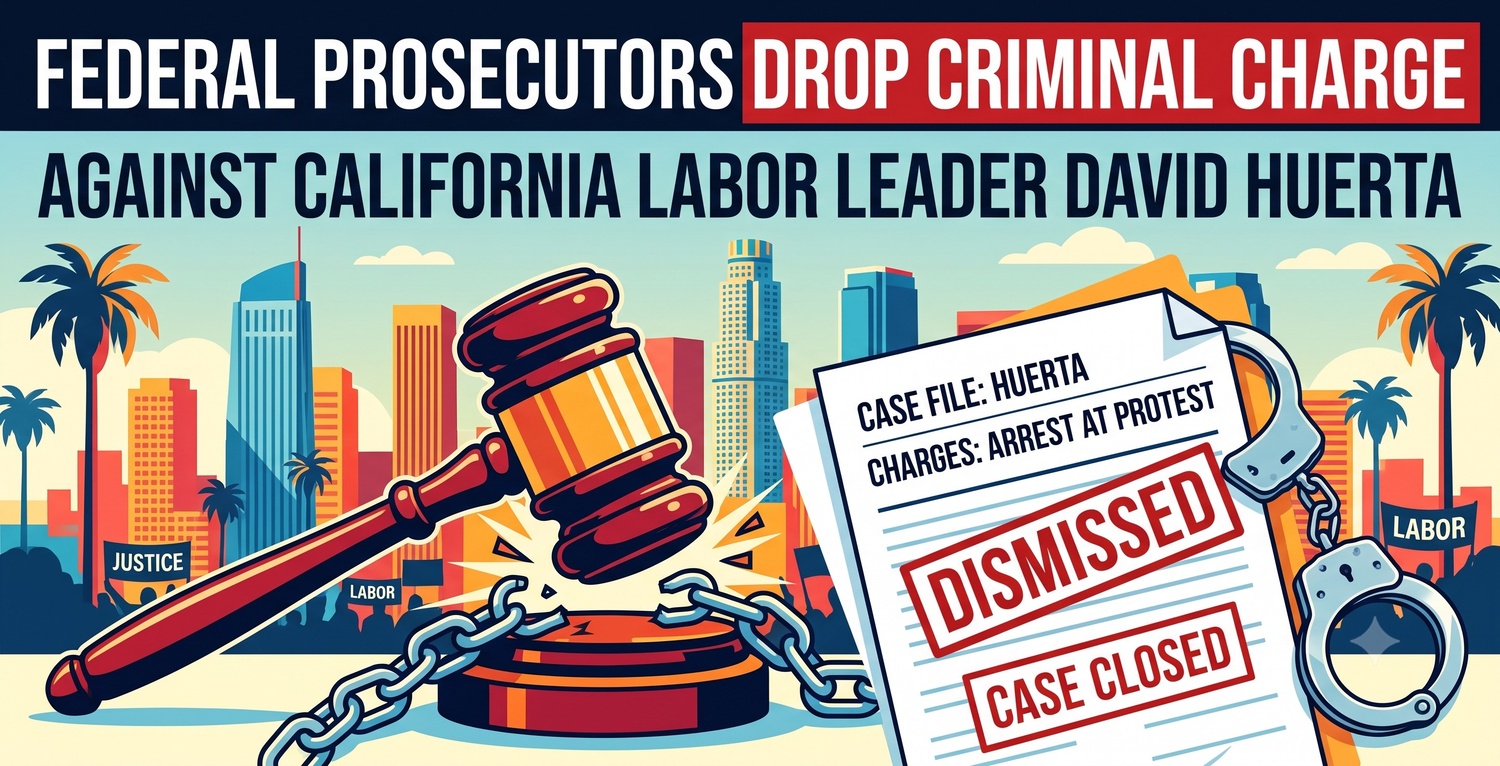
Federal prosecutors have moved to dismiss the criminal charge against California labor leader David Huerta following his 2025 Los Angeles immigration protest arrest.
Federal Prosecutors Move to Drop Charges Against California Labor Leader David Huerta
Federal prosecutors in Los Angeles have filed a motion to dismiss the remaining criminal charge against prominent California labor leader David Huerta. The decision marks a significant turning point in a high-profile legal battle that has fueled intense national debates surrounding federal immigration enforcement, union organizing, and First Amendment protest rights.
After more than a year of legal maneuvering and public scrutiny, the U.S. Attorney’s Office has signaled an end to its prosecution of David Huerta, president of the SEIU-United Service Workers West (SEIU-USWW). On Monday, federal prosecutors in Los Angeles submitted a motion to drop the misdemeanor obstruction charge stemming from his arrest during a contentious immigration protest in the summer of 2025.
The case against the influential labor leader—whose union represents hundreds of thousands of janitors, security officers, and allied service workers across California—had become a lightning rod for criticism. Labor advocates and civil rights groups argued the prosecution was a heavy-handed attempt to stifle dissent during a period of intensified federal immigration enforcement under the Trump administration. The impending dismissal not only resolves Huerta’s legal jeopardy but also casts a spotlight on the broader track record of federal protest-related prosecutions in Southern California.
The Ambiance Apparel Protest and Arrest
The origins of the legal dispute trace back to June 6, 2025. During the early phases of renewed, aggressive federal immigration sweeps in the Los Angeles metropolitan area, federal agents executed a search warrant at Ambiance Apparel. The raid was reportedly tied to an investigation into suspected immigration violations and the company’s employment practices.
As word of the raid spread, demonstrators quickly gathered outside the facility. Among them was David Huerta, a long-time advocate for immigrant labor rights.
According to the original criminal complaint filed by federal authorities, Huerta positioned himself directly in front of a vehicle gate. Prosecutors alleged he sat cross-legged at various points, paced deliberately to block vehicular and pedestrian access, and actively encouraged fellow demonstrators to disrupt the agents’ operations.
The situation escalated when a federal officer attempted to physically move the labor leader. The complaint stated that Huerta pushed back against the officer, resulting in the officer pushing Huerta to the ground. He was subsequently handcuffed, arrested, and transported to the Metropolitan Detention Center, where he was held for several days before securing release on a $50,000 bond.
Video footage of the physical takedown circulated rapidly across social media and national television networks, instantly elevating the incident from a localized protest to a national controversy.
Legal Proceedings and the Path to Dismissal
Initially, the Department of Justice pursued aggressive charges against Huerta. He was first slapped with a felony count of conspiring to impede a federal officer—a severe charge carrying the potential for significant prison time. Facing mounting public pressure and legal scrutiny, prosecutors later downgraded the indictment to a misdemeanor charge of obstruction, resistance, or opposition to a federal officer.
The arrest triggered immediate and widespread backlash. Union members orchestrated massive solidarity rallies across California. In Washington, D.C., California Democratic Senators Adam Schiff and Alex Padilla penned formal letters demanding a thorough review of the Justice Department’s actions, echoing sentiments from civil rights organizations that the arrest was politically motivated.
The Agreement and Conditions
In their filing on Monday, federal prosecutors indicated that the move to dismiss the case was made “pursuant to an agreement of the parties.”
The U.S. Attorney’s Office clarified that the case is on track to be fully and permanently dismissed by the end of August 2026, provided Huerta continues to comply strictly with the terms of his pretrial release and avoids any further legal infractions.
Statements from Prosecutors and the Defense
The resolution of the case has allowed both sides to claim a measure of victory, reflecting the deeply polarized nature of the prosecution.
U.S. Attorney Bill Essayli, who had previously utilized the Huerta case to emphasize that no individual is above the law when federal agents are executing their duties, offered a measured response to the dismissal. Speaking to reporters, Essayli stated that Huerta had “accepted responsibility” through the agreement, adding that the procedural outcome does not absolve the labor leader of underlying wrongdoing. Furthermore, the U.S. Attorney’s Office released a statement asserting that the DOJ “does not arrest people for peacefully protesting,” noting that Huerta had refrained from similar obstructive behaviors since his initial arrest.
“Vindication” for Labor Advocates
Conversely, Huerta and his robust legal defense team framed the government’s retreat as an undeniable vindication of First Amendment rights.
In a public statement following the filing, Huerta accused the government of “finally admitting what we knew from day one.” He characterized the charges as utterly baseless, designed specifically to intimidate immigrant communities and those who organize on their behalf.
“There was never a real case, only an attempt to punish and silence me for exercising my constitutional rights,” Huerta declared. He reaffirmed his commitment to challenging workplace abuses and advocating for the dignity of immigrant families.
His legal counsel, prominent attorneys Abbe Lowell and Marilyn Bednarski, issued blistering criticisms of the Justice Department. They condemned the strategic choice to charge a high-profile labor leader, hold the threat of federal prosecution over his head for over a year, and ultimately abandon the case only when it became apparent it could not withstand judicial scrutiny at trial.
Broader Context: First Amendment vs. Federal Operations
The dismissal of the Huerta case is not an isolated incident; rather, it fits into a broader, recognizable pattern emerging from the federal courts in Los Angeles.
Under the leadership of U.S. Attorney Bill Essayli, the district has aggressively pursued more than 100 criminal cases related to protests against federal immigration enforcement operations. While prosecutors have successfully secured guilty pleas in dozens of these cases—often through plea bargains—they have faced severe and repeated setbacks when defendants choose to take their cases to trial.
Statistics on Protest Prosecutions
According to judicial data compiled by mid-2026, the outcomes of these protest-related trials highlight the government’s struggle to secure convictions:
- Acquittals: Approximately 10 defendants have been fully acquitted at trial.
- Convictions: Only two convictions have been successfully secured by prosecutors at trial.
- Dismissals: At least 29 cases have been formally dismissed by the government prior to or during trial proceedings.
Legal analysts point to the inherent difficulties in prosecuting protest actions in the modern era. Laurie Levenson, a former federal prosecutor and current professor at Loyola Law School, noted that the Huerta prosecution was fraught with structural weaknesses from its inception.
The proliferation of high-definition video and photographic evidence allowed Huerta’s defense team to construct a formidable argument that his actions fell squarely under the umbrella of protected First Amendment protest activity, rather than criminal obstruction. Facing a jury trial with such visual evidence makes securing a conviction exceptionally challenging for federal prosecutors.
Timeline of Events
- June 6, 2025: Federal agents raid Ambiance Apparel in Los Angeles. David Huerta is arrested after a physical altercation with an officer while blocking a vehicle gate.
- Mid-June 2025: Huerta is charged with a felony for conspiring to impede a federal officer. He spends several days in the Metropolitan Detention Center before being released on a $50,000 bond.
- Late 2025: Following public outcry and pressure from U.S. Senators Adam Schiff and Alex Padilla, prosecutors reduce the charge to a misdemeanor.
- July 2026: The U.S. Attorney’s Office files a motion to dismiss the remaining misdemeanor charge pursuant to a mutual agreement.
- Late August 2026: Expected timeline for the case to be fully and permanently dismissed, pending Huerta’s compliance with pretrial conditions.
Impact on People, Business, and Government
The legal saga surrounding David Huerta carries profound implications for various sectors of American society.
For labor unions and immigrant workers, the dismissal acts as a powerful morale booster. SEIU-USWW members view the outcome as proof that organized, collective resistance can successfully withstand the pressures of the federal justice system. It emboldens organizers who focus on raising wages and improving working conditions for vulnerable populations.
For the federal government and law enforcement, the repeated dismissals and acquittals in Los Angeles may necessitate a strategic recalibration. The tension between executing lawful federal search warrants and respecting First Amendment protections has reached a boiling point. During the height of the 2025 immigration protests, the situation became so volatile that the National Guard was temporarily deployed to Los Angeles. The DOJ must now weigh the political and financial costs of pursuing marginal obstruction cases against peaceful demonstrators.
Future Developments
As the formal dismissal date approaches in late August, unresolved questions linger regarding the Justice Department’s long-term strategy for handling civil disobedience.
Legal advocacy groups are expected to leverage this dismissal in future court filings, citing it as precedent for defending other activists caught in similar dragnet operations. Meanwhile, immigrant rights organizations are gearing up for the 2026 midterm election cycle, using high-profile cases like Huerta’s to rally voter turnout against aggressive deportation policies.
Frequently Asked Questions (FAQs)
1. Who is David Huerta? David Huerta is a prominent California labor leader and the president of SEIU-United Service Workers West (SEIU-USWW), a union representing hundreds of thousands of janitors, security officers, and service workers.
2. Why was David Huerta arrested? Huerta was arrested on June 6, 2025, during a protest outside Ambiance Apparel in Los Angeles, where federal agents were conducting an immigration-related raid. He was accused of blocking a vehicle gate and physically resisting an officer.
3. What were the charges against Huerta? He was initially charged with a felony for conspiring to impede a federal officer. The charge was later reduced to a misdemeanor count of obstruction, resistance, or opposition to a federal officer.
4. Why are the charges being dismissed? Prosecutors filed a motion to dismiss the charges pursuant to an agreement between the parties. The DOJ noted Huerta had complied with pretrial release terms and had not engaged in further obstructive behavior, while his defense argued the case was constitutionally baseless from the start.
5. What is the SEIU? The Service Employees International Union (SEIU) is a major labor union representing almost 2 million workers across healthcare, public services, and property services in North America.
6. How have federal prosecutors fared in similar protest cases in LA? Under U.S. Attorney Bill Essayli, prosecutors have pursued over 100 similar cases. While many resulted in plea deals, cases taken to trial have largely failed, resulting in roughly 10 acquittals, 29 dismissals, and only 2 convictions by mid-2026.
The impending dismissal of charges against David Huerta closes a contentious chapter that began with a localized workplace raid and quickly evolved into a national symbol of political resistance. While federal prosecutors maintain that the agreement underscores accountability and compliance, labor advocates and legal experts view the government’s retreat as a critical victory for the First Amendment. As the courts continue to adjudicate the delicate balance between federal enforcement operations and the fundamental right to protest, Huerta’s case will likely serve as a defining benchmark for civil liberties in the modern era of immigration enforcement.
Author

admin@insiderglobal.news
Related Posts
Tom Homan Rejects Racial Profiling Claims by Angie Nixon
- 0
- 1,230 word
Border Czar Tom Homan dismisses Angie Nixon’s ICE racial profiling accusations as ridiculous. He stresses legal standards and equal enforcement. Read the...
- Angie Nixon slave catchers comment
- Border Czar equal opportunity deporter
- claims ICE will shoot citizens
- community trust vs safety
- Florida Senate immigration fight
- Fox News Homan interview
- Homan Fox News appearance
- Homan rejects profiling claims
- ICE racial profiling debate
- interior immigration operations
- multi-country deportations
- progressive vs enforcement views
- reasonable suspicion explained
- sanctuary cities ICE response
- Trump border enforcement

Elon Musk Targets 30 Daily Starship Launches by 2030
- 0
- 1,267 word
Elon Musk sets ambitious goal of 30+ Starship launches daily by 2030. Explore the leap from current flights, aviation comparison, and key...
- 10000 Starship flights year
- challenges to daily rocket launches
- future of orbital transport
- high-cadence spaceflight
- Musk 30 Starship launches daily
- Musk airplane comparison
- next era of space access
- propellant for daily launches
- rapid Earth-to-Earth rockets
- SpaceX 2030 launch goal
- SpaceX pad construction
- SpaceX Texas Florida expansion
- Starship airline-like cadence
- Starship flight test record
- Starship reusability push

Einride Orders 500 Tesla Semis for North America Fleet
- 0
- 1,066 word
Swedish firm Einride will phase in 500 Tesla Semis over 24 months, tripling its fleet for Amazon and others. Explore the $125M+...
- California Georgia freight corridors
- capacity without ownership
- commercial EV trucking
- Einride buys 500 Tesla Semis
- Einride revenue growth
- Einride triples fleet
- electric trucks for Amazon
- largest Tesla Semi order
- phased electric truck rollout
- Saga AI fleet management
- sustainable trucking milestone
- Tesla Semi 500-mile range
- Tesla Semi cost savings
- Tesla Semi North America
- zero-emission freight expansion

Trump Honors 16-year-old Ryder Williams Lifeguard Who Saved Boy from Rough Surf
- 0
- 1,218 word
President Trump honored 16-year-old lifeguard Ryder Williams and the boy he rescued at the White House. Learn about the heroic Santa Cruz...
- boy saved from waves honored
- California teen bravery
- courage under waves
- everyday hero recognition
- firefighter dream realized
- Lincoln Bedroom tour
- Nathaniel Rai White House
- Oval Office rescue story
- presidential honor ceremony
- rough surf survival
- Ryder Williams Trump meeting
- Santa Cruz hero visit
- teen lifeguard White House
- Trump praises lifeguard
- viral beach rescue president

USS Abraham Lincoln Faces Shortages After Record 260-Day Deployment
- 0
- 1,243 word
Families report food, soap, and plumbing shortages on the USS Abraham Lincoln after 260 days at sea. Officials push back as the...
- 260 days at sea
- Abraham Lincoln shortages
- carrier crew conditions
- combat carrier life
- Cooper visits Lincoln
- families raise alarm
- George Washington relief
- Hegseth response
- long deployment toll
- moldy showers ship
- Navy food reports
- Navy logistics challenges
- sailor mental health
- supply chain strain
- veteran pushes back

Minnesota Poll Workers Explain Voter Vouching in Undercover Video
- 0
- 1,390 word
Undercover footage captures Minnesota poll workers explaining how one registered voter can vouch for up to eight others. See official response and...
- Cam Higby burqa polling place
- election day vouching explained
- election security debate 2026
- false oath felony
- hidden camera Minnesota
- how vouching actually works
- Minneapolis primary undercover
- Minnesota poll workers video
- O’Keefe exposes vouching
- rare use of vouching data
- reform after video release
- SAVE America Act push
- Secretary of State reacts
- voter vouching loophole claim
- you’re the ID clip