- 0
- 1,390 word
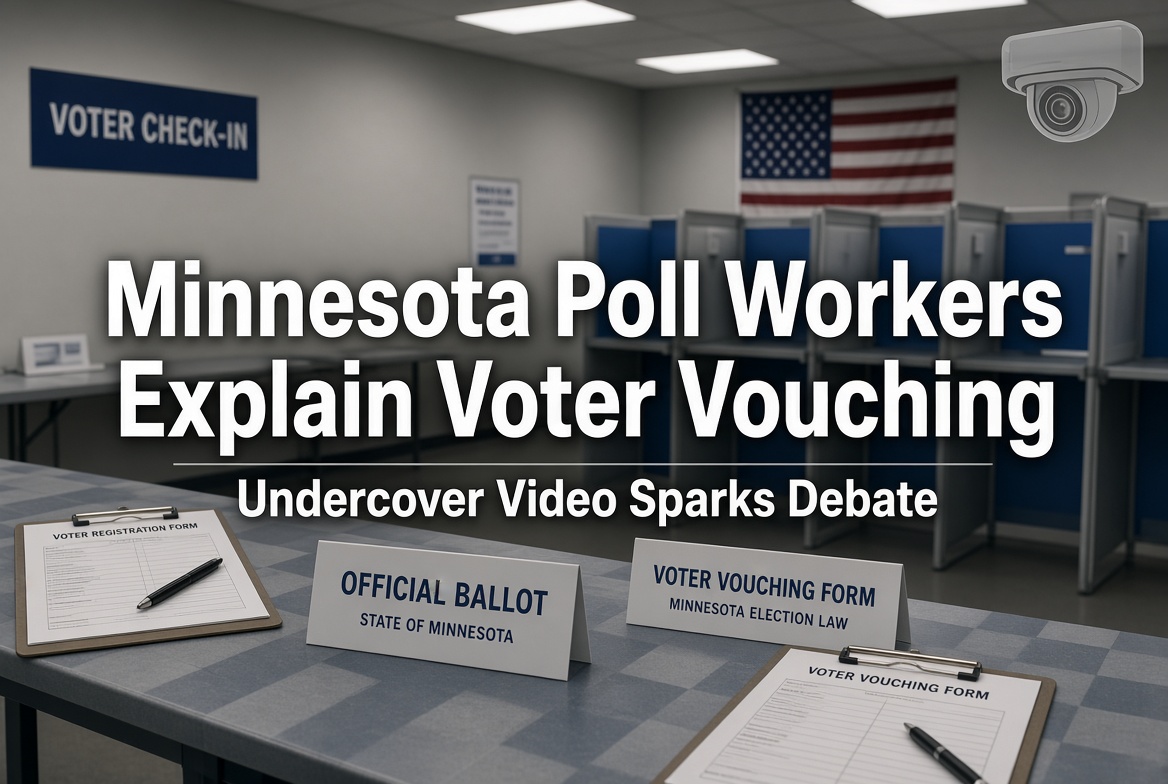
Undercover footage captures Minnesota poll workers explaining how one registered voter can vouch for up to eight others. See official response and reform calls.
Hidden-camera footage released by James O’Keefe and Cam Higby shows Minnesota poll workers describing the state’s voter vouching process during the August 11 primary. Workers confirmed that a registered voter in the same precinct can vouch for up to eight unregistered individuals as proof of residence. Minnesota’s Secretary of State labeled the operation outrageous and said law enforcement is reviewing it, while conservatives called for stronger federal ID requirements.
On primary election day in Minneapolis, undercover journalists associated with O’Keefe Media Group and the group calling itself the Justice League visited several polling places. The footage, released in mid-August 2026, captures conversations in which election workers outline how Minnesota’s longstanding vouching provision works. The videos quickly circulated online and prompted reactions from elected officials and election administrators.
What the Footage Shows
In the recordings, one poll worker tells an individual posing as a registered voter that he can serve as identification for others. “You’re the ID,” the worker says, according to the released clips. Another exchange confirms that a single registered voter may vouch for as many as eight people who are not yet registered, provided they all reside in the same precinct.
Cam Higby appears in one segment wearing a burqa and records interactions in which a worker discusses the possibility of voting under a given name and vouching for additional people. The journalists state that they did not cast ballots or complete registration forms. Their stated purpose was to document how election workers apply the vouching rules in practice.
Minnesota law has permitted this form of proof of residence for more than 50 years. Under the statute, a registered voter from the same precinct may sign an oath affirming that another person lives in the precinct. The limit is eight individuals per voucher on any election day. A person who was themselves vouched for that day may not vouch for others. Residential facility staff may vouch for residents under separate rules.
Official Response from Election Officials
Minnesota Secretary of State Steve Simon issued a statement condemning the visits. He described the group’s actions as “outrageous” misconduct involving impersonation at polling places. Simon said poll workers immediately reported the encounters to local officials, and law enforcement is reviewing the situation.
Simon emphasized that the group’s apparent goal was to cast doubt on Minnesota election laws that have operated for decades. He argued the visitors revealed a misunderstanding of how the process actually functions. According to the Secretary of State’s office, anyone who registers or updates registration on Election Day—including those who use vouching—is recorded by local officials. Later verification checks registrations against state databases. Knowingly providing false information on an oath constitutes a felony.
Official data shows vouching is used infrequently. In the 2024 general election, less than 0.6 percent of votes involved the process. Roughly 71 percent of those instances involved already-registered voters who needed only to update name or address information.
Calls for Federal Reform
The videos prompted immediate reaction from some members of Congress and conservative commentators. Senator Mike Lee and others pointed to the footage as evidence supporting the proposed SAVE America Act, legislation that would require proof of citizenship and photo identification for voting in federal elections. Supporters of stricter rules argue that reliance on personal vouching creates opportunities for abuse even if formal safeguards exist after the fact.
Critics of the undercover operation counter that the journalists staged extreme scenarios and that Minnesota’s system includes post-election checks and criminal penalties. They note that the state has maintained the vouching option for decades without widespread documented fraud of the type alleged in the videos.
Background on Minnesota’s Election Day Registration
Minnesota is among a small number of states that allow voters to register and cast a ballot on the same day. Eligible residents must provide proof of identity and residence. Acceptable documents include a Minnesota driver’s license or ID with current address, certain photo IDs paired with a utility bill or lease, or the vouching option described above.
The vouching provision is intended to accommodate voters who lack traditional documents while still requiring an oath from someone already on the rolls in that precinct. Election judges track the number of oaths signed by each voucher to enforce the eight-person limit. After the election, officials compare new registrations against existing records and other databases.
Timeline of Events
- August 11, 2026: Minnesota primary election day. Undercover team visits Minneapolis polling places.
- August 12–13: Initial clips and statements appear on social media.
- August 13–14: Full videos released by O’Keefe Media Group and Cam Higby.
- August 14: Secretary of State Steve Simon issues public statement calling the conduct outrageous and confirming a law enforcement review.
- Following days: National commentary and renewed discussion of federal voter ID proposals.
Impact and Broader Debate
The episode has intensified the national conversation about election security versus access. Supporters of Minnesota’s current rules highlight the rarity of vouching, the existence of criminal penalties for false statements, and the state’s history of high voter turnout with relatively few proven cases of systemic fraud tied to this method. Opponents argue that any system allowing one person to effectively authorize multiple others without contemporaneous photo ID or documentary proof of identity invites risk, particularly in large urban precincts.
For poll workers, the videos create additional scrutiny and potential security concerns at future elections. Election administrators stress that workers followed existing law by explaining the rules accurately. For voters, the episode may increase awareness of both the vouching option and the legal consequences of misrepresentation.
Future Developments
Law enforcement continues to review the polling-place visits. No charges had been announced as of the latest available statements. Legislative interest in both state-level adjustments to the eight-person limit and federal citizenship-and-ID requirements is expected to continue into the next session. Minnesota election officials have indicated they will maintain existing procedures while monitoring any formal investigations.
The videos themselves remain publicly available and form the primary documentary record of the interactions. Both the journalists and state officials have released written statements clarifying their positions on what occurred and what the law requires.
Frequently Asked Questions
What did the undercover video show? It captured Minnesota poll workers explaining that a registered voter in the same precinct can vouch for up to eight people as proof of residence and describing the registered voter as serving as the form of identification for those individuals.
Did the journalists cast ballots? According to statements from O’Keefe Media Group, the team did not cast ballots or complete registration forms. They asked questions and recorded the responses.
What is Minnesota’s official response? Secretary of State Steve Simon called the impersonation and hidden-camera activity outrageous, said poll workers reported it immediately, and confirmed that law enforcement is reviewing the matter.
Is vouching legal in Minnesota? Yes. State law has allowed a registered voter to vouch for up to eight others in the same precinct for more than 50 years. False statements on the required oath are a felony.
How often is vouching used? In the 2024 general election, less than 0.6 percent of votes involved the vouching process. Most of those cases involved already-registered voters updating information.
What happens after someone is vouched for? Local election officials record the registration or update. Later verification compares the information against state databases. Misrepresentation remains a criminal offense.
What reform proposals have been mentioned? Some lawmakers and commentators have cited the videos in support of the SAVE America Act, which would require proof of citizenship and photo ID for federal elections.
The undercover videos released by James O’Keefe and Cam Higby document Minnesota poll workers accurately describing the state’s voter vouching rules during the 2026 primary. Those rules permit one registered voter to affirm the residence of up to eight others in the same precinct. State election officials maintain that the process is rarely used, subject to later verification, and backed by felony penalties for false statements, while characterizing the journalists’ methods as unacceptable. The episode has added fuel to ongoing national debates over identification requirements and election procedures. As any formal review proceeds, both the legal framework and the practical application of vouching remain subjects of public scrutiny.
- Cam Higby burqa polling place
- election day vouching explained
- election security debate 2026
- false oath felony
- hidden camera Minnesota
- how vouching actually works
- Minneapolis primary undercover
- Minnesota poll workers video
- O’Keefe exposes vouching
- rare use of vouching data
- reform after video release
- SAVE America Act push
- Secretary of State reacts
- voter vouching loophole claim
- you’re the ID clip
Author

admin@insiderglobal.news
Related Posts
Tom Homan Rejects Racial Profiling Claims by Angie Nixon
- 0
- 1,230 word
Border Czar Tom Homan dismisses Angie Nixon’s ICE racial profiling accusations as ridiculous. He stresses legal standards and equal enforcement. Read the...
- Angie Nixon slave catchers comment
- Border Czar equal opportunity deporter
- claims ICE will shoot citizens
- community trust vs safety
- Florida Senate immigration fight
- Fox News Homan interview
- Homan Fox News appearance
- Homan rejects profiling claims
- ICE racial profiling debate
- interior immigration operations
- multi-country deportations
- progressive vs enforcement views
- reasonable suspicion explained
- sanctuary cities ICE response
- Trump border enforcement

Elon Musk Targets 30 Daily Starship Launches by 2030
- 0
- 1,267 word
Elon Musk sets ambitious goal of 30+ Starship launches daily by 2030. Explore the leap from current flights, aviation comparison, and key...
- 10000 Starship flights year
- challenges to daily rocket launches
- future of orbital transport
- high-cadence spaceflight
- Musk 30 Starship launches daily
- Musk airplane comparison
- next era of space access
- propellant for daily launches
- rapid Earth-to-Earth rockets
- SpaceX 2030 launch goal
- SpaceX pad construction
- SpaceX Texas Florida expansion
- Starship airline-like cadence
- Starship flight test record
- Starship reusability push

Einride Orders 500 Tesla Semis for North America Fleet
- 0
- 1,066 word
Swedish firm Einride will phase in 500 Tesla Semis over 24 months, tripling its fleet for Amazon and others. Explore the $125M+...
- California Georgia freight corridors
- capacity without ownership
- commercial EV trucking
- Einride buys 500 Tesla Semis
- Einride revenue growth
- Einride triples fleet
- electric trucks for Amazon
- largest Tesla Semi order
- phased electric truck rollout
- Saga AI fleet management
- sustainable trucking milestone
- Tesla Semi 500-mile range
- Tesla Semi cost savings
- Tesla Semi North America
- zero-emission freight expansion
Trump Honors 16-year-old Ryder Williams Lifeguard Who Saved Boy from Rough Surf
- 0
- 1,218 word
President Trump honored 16-year-old lifeguard Ryder Williams and the boy he rescued at the White House. Learn about the heroic Santa Cruz...
- boy saved from waves honored
- California teen bravery
- courage under waves
- everyday hero recognition
- firefighter dream realized
- Lincoln Bedroom tour
- Nathaniel Rai White House
- Oval Office rescue story
- presidential honor ceremony
- rough surf survival
- Ryder Williams Trump meeting
- Santa Cruz hero visit
- teen lifeguard White House
- Trump praises lifeguard
- viral beach rescue president
USS Abraham Lincoln Faces Shortages After Record 260-Day Deployment
- 0
- 1,243 word
Families report food, soap, and plumbing shortages on the USS Abraham Lincoln after 260 days at sea. Officials push back as the...
- 260 days at sea
- Abraham Lincoln shortages
- carrier crew conditions
- combat carrier life
- Cooper visits Lincoln
- families raise alarm
- George Washington relief
- Hegseth response
- long deployment toll
- moldy showers ship
- Navy food reports
- Navy logistics challenges
- sailor mental health
- supply chain strain
- veteran pushes back

Marvel Reveals X-Men Cast for 2028 MCU Movie at D23
- 0
- 1,110 word
Marvel Studios revealed the X-Men cast at D23, led by Sadie Sink as Jean Grey. See the full lineup including Adam Driver...