- 0
- 1,681 word
SpaceX Starship Flight 13 Success: Starlink V3 & Splashdown
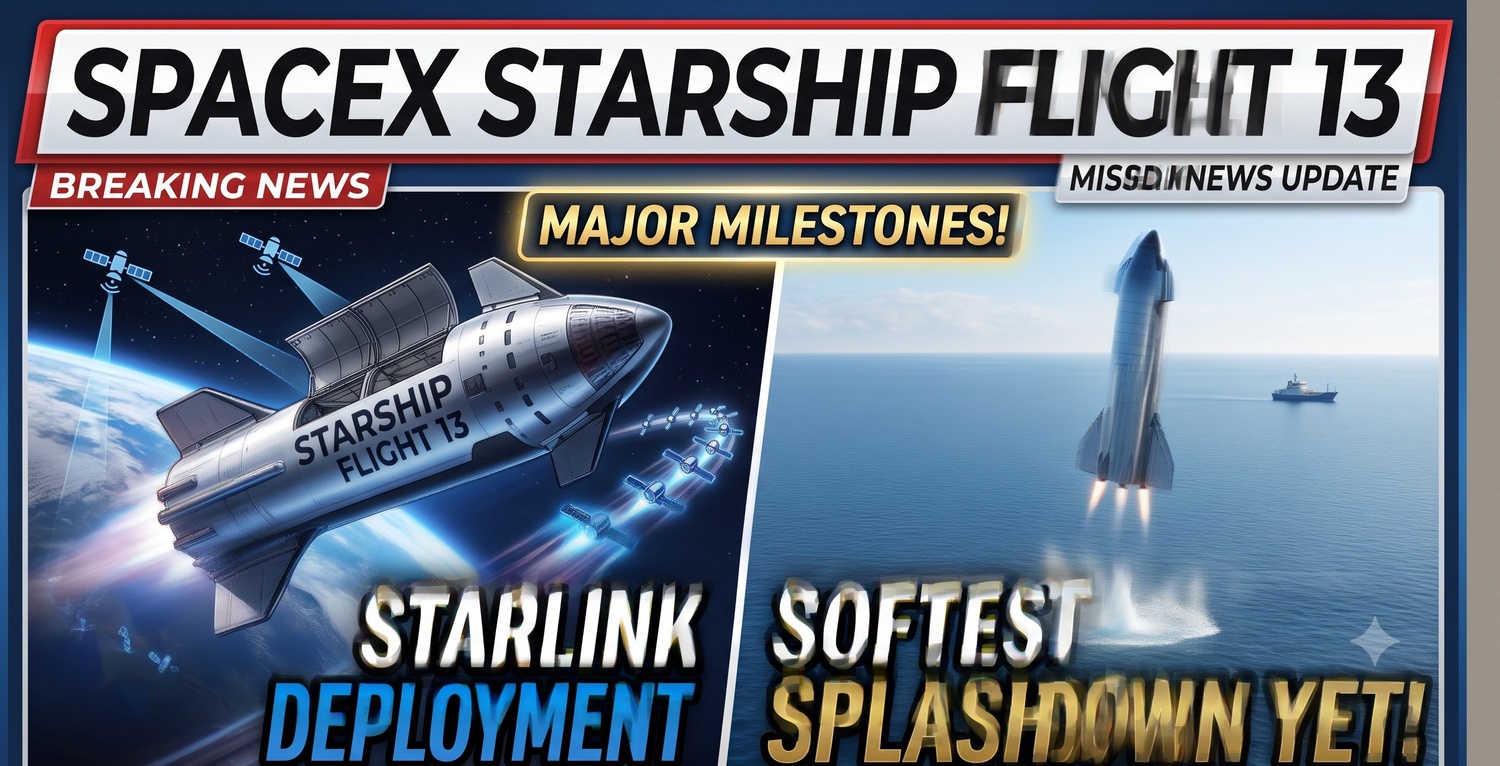
SpaceX Starship Flight 13 Achieves Major Milestones with First Starlink V3 Deployment and Intact Splashdown
SpaceX completed the 13th integrated flight test of its massive Starship launch vehicle on July 24, 2026. The historic mission featured the first operational deployment of next-generation Starlink V3 satellites, a record-setting in-space Raptor engine relight, and the softest ocean splashdown of the upper stage in the program’s history.
Introduction: The aerospace industry witnessed a monumental leap forward as SpaceX’s towering Starship rocket roared to life from the Gulf Coast of Texas. Lifting off on the evening of July 24, 2026, at 5:51 p.m. Central Time, SpaceX Starship Flight 13 pushed the boundaries of reusable rocket engineering and deep-space logistics.
Operating from the newly constructed Pad 2 at Starbase in South Texas, this mission utilized the upgraded Version 3 (V3) hardware architecture. The launch addressed critical operational goals that are vital to both the expansion of the commercial Starlink network and humanity’s return to the Moon. From a flawless ascent to an intact water landing, Flight 13 proved that the world’s most powerful launch vehicle is rapidly maturing into an operational workhorse.
A Historic Liftoff at Starbase South Texas
The sheer scale of the Starship system is unprecedented. The 124-meter-tall (407-foot) stack, comprising Super Heavy Booster 20 and the Ship 40 upper stage, initiated its ascent with a flawless ignition sequence. For the first time in recent testing history, all 33 Raptor engines on the Super Heavy booster lit cleanly, providing a high-acceleration climb through the atmosphere.
This marked the second flight of the more powerful V3 configuration. The V3 system features highly iterated Raptor engines and refined structural performance parameters designed specifically for demanding future orbital missions and heavy-lift crewed flights.
Overcoming Earlier Launch Aborts
The road to Flight 13’s success required overcoming late-stage technical hurdles. An initial launch attempt on July 16 was dramatically aborted at T-0 due to anomalous engine start conditions. SpaceX engineers quickly pivoted, executing rapid engine replacements and a rigorous series of localized tests on the pad. The flawless liftoff on July 24 vindicated the team’s rapid troubleshooting and iterating methodology.
Super Heavy Booster’s Hard Splashdown
Following a successful stage separation, Super Heavy Booster 20 executed its boostback burn flawlessly, aiming for a controlled splashdown in the Gulf of Mexico. However, the descent highlighted the extreme complexities of returning a 71-meter booster back to Earth.
During the final landing burn sequence, only a subset of the targeted Raptor engines successfully reignited. Telemetry and visual reports indicated that as few as five to eight of the expected 13 engines lit, resulting in a harder-than-planned impact with the ocean surface.
Preparing for Future Tower Catches
Despite the hard splashdown, SpaceX declared the booster’s return highly valuable. The primary objective of these water landings is to gather high-fidelity engineering data to perfect the landing burn software. This data is the critical stepping stone toward SpaceX’s ultimate goal: catching the Super Heavy booster directly out of the air using the massive “Mechazilla” chopstick arms at the launch tower. Mastering this catch mechanism is essential for the rapid reusability required for future missions.
Starlink V3 Deployment and In-Space Relight
While the booster returned to Earth, the Starship upper stage (Ship 40) coasted perfectly into its planned suborbital trajectory, achieving several program “firsts” along the way.
The most anticipated payload milestone was the successful deployment of 20 operational Starlink V3 satellites. Previous test flights had only carried mass simulators (dummy payloads), making Flight 13 the first time functional next-generation hardware flew inside Starship’s massive payload bay.
First Real Starlink V3 Satellites Flown
Once deployed, the 20 satellites underwent roughly 20 minutes of rigorous in-space testing. They successfully extended their large solar arrays and communications antennas. SpaceX engineers on the ground confirmed active communications with every single satellite via both standard radio frequency and high-bandwidth laser links.
Because Ship 40’s trajectory was deliberately suborbital, these satellites were not meant to stay in space. After the testing window concluded, they safely reentered Earth’s atmosphere and burned up by design. This successful demonstration clears the path for SpaceX to eventually launch up to 60 of the larger, heavier V3 satellites per flight—vastly outperforming the payload capacity of the current Falcon 9 fleet.
Longest In-Space Raptor Engine Relight
During the coast phase, Ship 40 successfully executed an in-space relight of a single Raptor engine that lasted approximately 14 seconds. This represents the longest in-space engine relight demonstrated by Starship to date. Mastering in-space propulsion restarts is an absolute necessity for complex orbital insertions, safe deorbit burns, and the deep-space maneuvers required for NASA’s lunar operations.
The “Softest Splashdown Yet” for Ship 40
Returning a spacecraft the size of Starship through the searing heat of atmospheric reentry is one of aerospace engineering’s greatest challenges. Flight 13 provided unparalleled data on Starship’s thermal protection system.
During reentry, cameras—including those uniquely positioned on the deployed Starlink satellites—captured stunning views of the plasma envelope surrounding the vehicle. The heat shield performed exceptionally well, with a vast majority of the hexagonal black ceramic tiles remaining firmly attached throughout peak heating and maximum dynamic pressure.
Heat Shield Performance and Telemetry
In the final moments of the flight, Ship 40 successfully executed its signature “belly flop” maneuver, followed by a landing flip and a powered landing burn utilizing three Raptor engines. Approximately 65 minutes after liftoff, the vehicle achieved what SpaceX officially dubbed its “softest-ever splashdown” in the Indian Ocean.
Unlike previous iterations that broke apart upon impact, Ship 40 settled into the water largely intact. It remained floating on the surface, continuously transmitting invaluable imagery and telemetry back to Starbase.
SpaceX spokesperson Dan Huot captured the mood during the official webcast, stating: “This is a dream scenario for the team that’s trying to get this heat shield data”. SpaceX CEO Elon Musk echoed this sentiment on social media, praising the vehicle’s survival and the immense quality of the collected flight data.
Background Information
The success of SpaceX Starship Flight 13 cannot be overstated within the broader context of global space exploration. Starship was selected by NASA to serve as the Human Landing System (HLS) for the Artemis III mission, which aims to return American astronauts to the lunar surface. To achieve this, Starship must prove it can reliably reach orbit, transfer cryogenic propellants in space, and land safely. Furthermore, the commercial viability of SpaceX relies heavily on the Starlink V3 constellation, which promises to deliver direct-to-cell internet connectivity worldwide.
Timeline of Events (Flight 13)
- July 16, 2026: Initial launch attempt aborted at T-0 due to anomalous engine start signatures.
- July 24, 2026 (5:51 p.m. CT): Liftoff from Pad 2 at Starbase; all 33 Raptor engines ignite successfully.
- T+ 2 minutes, 45 seconds: Successful hot-staging and separation of Super Heavy Booster 20.
- T+ 7 minutes: Super Heavy Booster executes a hard splashdown in the Gulf of Mexico after partial engine reignition.
- T+ 25 minutes: Ship 40 successfully deploys 20 operational Starlink V3 satellites.
- T+ 40 minutes: Starship executes a successful 14-second in-space Raptor engine relight.
- T+ 65 minutes: Ship 40 completes a powered landing burn, achieving an intact, soft splashdown in the Indian Ocean.
Impact on People, Business, and Government
The validation of the Starlink V3 deployment mechanism directly impacts global telecommunications. With the ability to deploy 60 of these massive satellites per launch, SpaceX is positioned to corner the market on high-bandwidth, direct-to-smartphone satellite internet.
For the U.S. Government and NASA, Flight 13 eases anxieties surrounding the timeline of the Artemis program. Demonstrating a stable reentry and an intact landing proves that the foundational physics and engineering principles behind Starship’s heat shield and aerodynamics are sound.
Future Developments
With Pad 2 at Starbase now fully operational, SpaceX is primed to significantly increase its launch cadence. Engineers are currently analyzing the vast troves of telemetry gathered from Booster 20’s hard landing to refine the software for the upcoming Flight 14. The aerospace community eagerly anticipates that future flights will finally attempt the highly ambitious “Mechazilla” tower catch, bringing SpaceX one step closer to an airline-like operational model for spaceflight.
Frequently Asked Questions
1. What were the primary achievements of SpaceX Starship Flight 13? The flight achieved the first successful deployment of operational Starlink V3 satellites, completed a 14-second in-space Raptor engine relight, and executed the softest and most intact ocean splashdown of the Ship upper stage in program history.
2. Did the Super Heavy booster land successfully? The booster completed its boostback burn and reached its target in the Gulf of Mexico. However, only 5 to 8 of the planned 13 landing engines ignited, resulting in a harder-than-intended water impact.
3. What are Starlink V3 satellites? Starlink V3 satellites are SpaceX’s next-generation telecommunications hardware. They are larger, heavier, and offer vastly more bandwidth capacity than previous versions, requiring the massive payload volume of Starship to reach orbit efficiently.
4. Why did the satellites burn up in the atmosphere? The 20 Starlink V3 satellites deployed during Flight 13 were flown on an intentionally suborbital trajectory. After 20 minutes of successful communications and hardware testing, their flight path naturally brought them back into Earth’s atmosphere, where they safely burned up by design to prevent space debris.
5. What is the significance of the in-space Raptor relight? Relighting an engine in the vacuum of space is a highly complex maneuver. Proving this capability is mandatory for Starship to eventually perform orbital insertions, safely deorbit, and execute the deep-space burns necessary for missions to the Moon and Mars.
6. When will SpaceX attempt to catch the booster with the launch tower? While SpaceX has not announced an exact date, the data gathered during the ocean landing of Flight 13 is being actively used to refine the software for a future tower catch using the “Mechazilla” arms, which could happen as early as Flight 14 or 15.
SpaceX Starship Flight 13 will be remembered as the mission where theoretical architectures transitioned into operational reality. By proving the vehicle can deploy heavy, next-generation commercial payloads, reliably restart its engines in the vacuum of space, and survive the hellish conditions of atmospheric reentry intact, SpaceX has validated the core tenets of the Starship program. As data is parsed and hardware is rapidly iterated at Starbase, the dream of a fully and rapidly reusable interplanetary transport system has never been closer to fruition.
Author

admin@insiderglobal.news
Related Posts

Tom Homan Rejects Racial Profiling Claims by Angie Nixon
- 0
- 1,230 word
Border Czar Tom Homan dismisses Angie Nixon’s ICE racial profiling accusations as ridiculous. He stresses legal standards and equal enforcement. Read the...
- Angie Nixon slave catchers comment
- Border Czar equal opportunity deporter
- claims ICE will shoot citizens
- community trust vs safety
- Florida Senate immigration fight
- Fox News Homan interview
- Homan Fox News appearance
- Homan rejects profiling claims
- ICE racial profiling debate
- interior immigration operations
- multi-country deportations
- progressive vs enforcement views
- reasonable suspicion explained
- sanctuary cities ICE response
- Trump border enforcement
Elon Musk Targets 30 Daily Starship Launches by 2030
- 0
- 1,267 word
Elon Musk sets ambitious goal of 30+ Starship launches daily by 2030. Explore the leap from current flights, aviation comparison, and key...
- 10000 Starship flights year
- challenges to daily rocket launches
- future of orbital transport
- high-cadence spaceflight
- Musk 30 Starship launches daily
- Musk airplane comparison
- next era of space access
- propellant for daily launches
- rapid Earth-to-Earth rockets
- SpaceX 2030 launch goal
- SpaceX pad construction
- SpaceX Texas Florida expansion
- Starship airline-like cadence
- Starship flight test record
- Starship reusability push

Einride Orders 500 Tesla Semis for North America Fleet
- 0
- 1,066 word
Swedish firm Einride will phase in 500 Tesla Semis over 24 months, tripling its fleet for Amazon and others. Explore the $125M+...
- California Georgia freight corridors
- capacity without ownership
- commercial EV trucking
- Einride buys 500 Tesla Semis
- Einride revenue growth
- Einride triples fleet
- electric trucks for Amazon
- largest Tesla Semi order
- phased electric truck rollout
- Saga AI fleet management
- sustainable trucking milestone
- Tesla Semi 500-mile range
- Tesla Semi cost savings
- Tesla Semi North America
- zero-emission freight expansion

Trump Honors 16-year-old Ryder Williams Lifeguard Who Saved Boy from Rough Surf
- 0
- 1,218 word
President Trump honored 16-year-old lifeguard Ryder Williams and the boy he rescued at the White House. Learn about the heroic Santa Cruz...
- boy saved from waves honored
- California teen bravery
- courage under waves
- everyday hero recognition
- firefighter dream realized
- Lincoln Bedroom tour
- Nathaniel Rai White House
- Oval Office rescue story
- presidential honor ceremony
- rough surf survival
- Ryder Williams Trump meeting
- Santa Cruz hero visit
- teen lifeguard White House
- Trump praises lifeguard
- viral beach rescue president
USS Abraham Lincoln Faces Shortages After Record 260-Day Deployment
- 0
- 1,243 word
Families report food, soap, and plumbing shortages on the USS Abraham Lincoln after 260 days at sea. Officials push back as the...
- 260 days at sea
- Abraham Lincoln shortages
- carrier crew conditions
- combat carrier life
- Cooper visits Lincoln
- families raise alarm
- George Washington relief
- Hegseth response
- long deployment toll
- moldy showers ship
- Navy food reports
- Navy logistics challenges
- sailor mental health
- supply chain strain
- veteran pushes back

Minnesota Poll Workers Explain Voter Vouching in Undercover Video
- 0
- 1,390 word
Undercover footage captures Minnesota poll workers explaining how one registered voter can vouch for up to eight others. See official response and...
- Cam Higby burqa polling place
- election day vouching explained
- election security debate 2026
- false oath felony
- hidden camera Minnesota
- how vouching actually works
- Minneapolis primary undercover
- Minnesota poll workers video
- O’Keefe exposes vouching
- rare use of vouching data
- reform after video release
- SAVE America Act push
- Secretary of State reacts
- voter vouching loophole claim
- you’re the ID clip