- 0
- 574 words
U.S. Air Force Severs Iran’s Critical Rail Lifeline to Russia and China
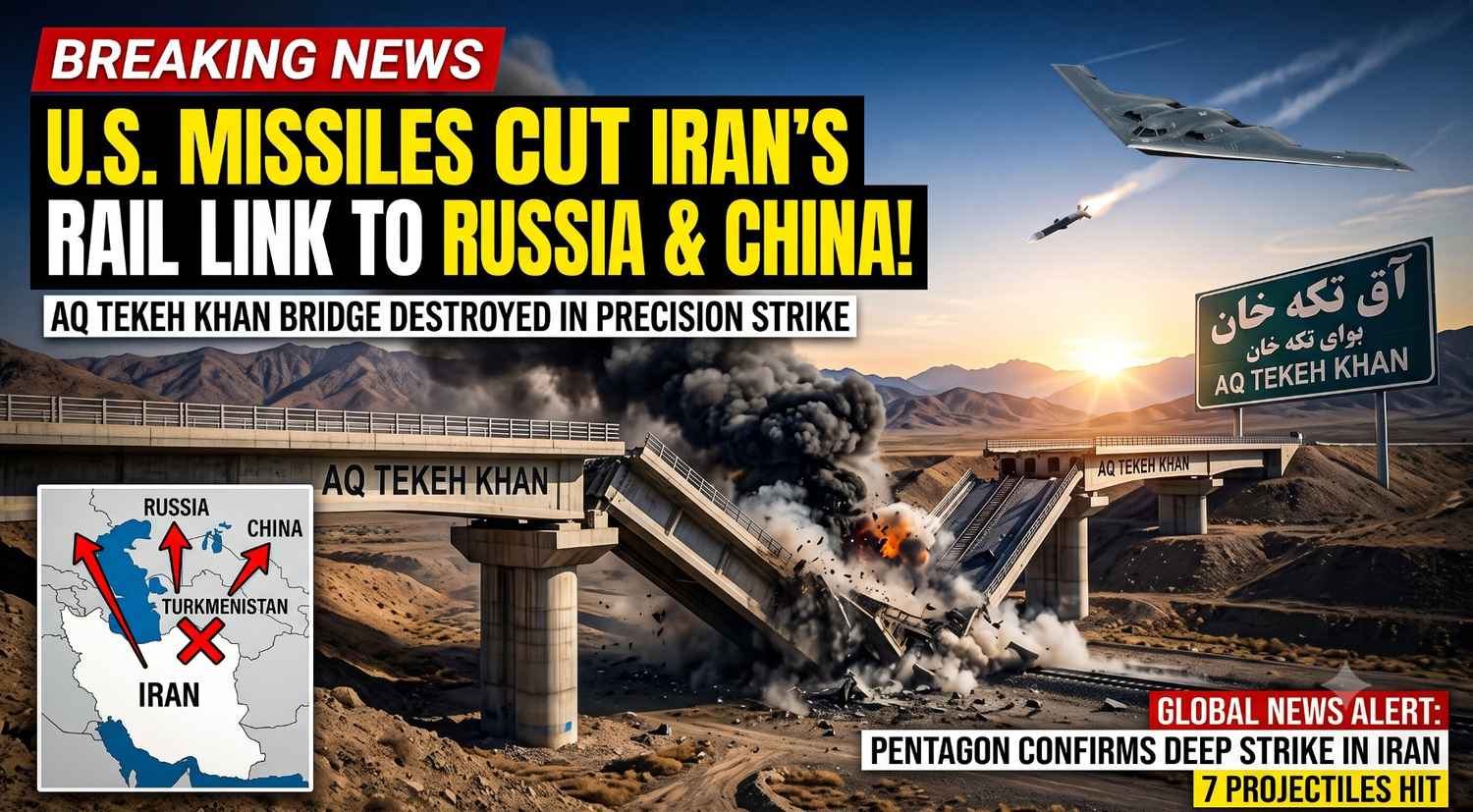
In a precision strike that underscores Washington’s escalating pressure campaign, the U.S. Air Force has surgically dismantled the Aq Tekeh Khan railway bridge in Iran’s Golestan province. The attack, carried out with cruise missiles in the early hours of July 9, 2026, effectively cut a vital land artery linking Tehran to Russia and China—the primary overland bypass Iran has leaned on while its southern ports face a tightening U.S. naval blockade.
This was no random hit. The Aq Tekeh Khan bridge sits on the China-Kazakhstan-Turkmenistan-Incheh Borun rail corridor, a key segment of the broader North-South Transport Corridor and China’s Belt and Road Initiative. For months, Tehran has funneled goods northward through Turkmenistan and Kazakhstan to keep its economy breathing under sanctions and maritime restrictions. Trains from China to Iran had tripled in volume amid the Hormuz squeeze, and Russia had begun regular shipments via the same route late last year. By vaporizing this link near the Turkmenistan border—one of the deepest U.S. strikes inside Iranian territory yet—Washington signaled it is no longer content merely throttling Iran’s navy. It is systematically choking every major logistical artery the regime relies on.
Iranian state media and the IRGC’s Neynava Corps confirmed the strike, reporting seven “enemy projectiles” hit the bridge with no casualties. Emergency crews raced to assess damage; one rail line was reportedly restored within 13 hours, a familiar pattern after previous U.S. and Israeli hits on Iranian bridges earlier this year. U.S. Central Command framed the operation as part of broader strikes on more than 90 Iranian targets aimed at degrading Tehran’s ability to threaten freedom of navigation in the Strait of Hormuz. President Trump declared a previous ceasefire over, warning of “20-to-1” retaliation for any Iranian response.
The strategic message is unmistakable. Iran’s leadership had treated the land corridor as a pressure-release valve—an insurance policy against naval isolation. With maritime routes under blockade and oil exports throttled, the northern rail became the regime’s economic oxygen line. Severing it forces Tehran into a far tighter corner: either escalate and risk further devastation of its infrastructure, or watch trade with its two most important partners grind to a crawl.
Analysts note this is classic American power projection using air and missile dominance to dismantle an adversary’s workarounds without committing ground forces. Previous strikes on six Iranian railway bridges in April showed how quickly Tehran rebuilds. Yet each hit raises the cost, delays shipments, and compounds the economic strain already biting into the regime’s ability to fund proxies and missile programs.
Iran has already retaliated with missile attacks on U.S. bases in the region and a strike on a Jordanian air base it claims hosts American command elements. The cycle of action and reaction continues, but the bridge strike marks a qualitative shift: the United States is no longer just playing defense in the Gulf. It is methodically dismantling Iran’s entire sanctions-evasion architecture, one critical node at a time.
For American audiences watching the long contest with Tehran, this operation offers a clear demonstration of resolve and capability. The regime’s hopes of outlasting pressure through Eurasian land routes just took a direct hit. Whether Tehran can repair the damage fast enough—or find new workarounds—will shape the next phase of this confrontation.
Author

admin@insiderglobal.news
Related Posts

Tom Homan Rejects Racial Profiling Claims by Angie Nixon
- 0
- 1,230 word
Border Czar Tom Homan dismisses Angie Nixon’s ICE racial profiling accusations as ridiculous. He stresses legal standards and equal enforcement. Read the...
- Angie Nixon slave catchers comment
- Border Czar equal opportunity deporter
- claims ICE will shoot citizens
- community trust vs safety
- Florida Senate immigration fight
- Fox News Homan interview
- Homan Fox News appearance
- Homan rejects profiling claims
- ICE racial profiling debate
- interior immigration operations
- multi-country deportations
- progressive vs enforcement views
- reasonable suspicion explained
- sanctuary cities ICE response
- Trump border enforcement

Elon Musk Targets 30 Daily Starship Launches by 2030
- 0
- 1,267 word
Elon Musk sets ambitious goal of 30+ Starship launches daily by 2030. Explore the leap from current flights, aviation comparison, and key...
- 10000 Starship flights year
- challenges to daily rocket launches
- future of orbital transport
- high-cadence spaceflight
- Musk 30 Starship launches daily
- Musk airplane comparison
- next era of space access
- propellant for daily launches
- rapid Earth-to-Earth rockets
- SpaceX 2030 launch goal
- SpaceX pad construction
- SpaceX Texas Florida expansion
- Starship airline-like cadence
- Starship flight test record
- Starship reusability push

Einride Orders 500 Tesla Semis for North America Fleet
- 0
- 1,066 word
Swedish firm Einride will phase in 500 Tesla Semis over 24 months, tripling its fleet for Amazon and others. Explore the $125M+...
- California Georgia freight corridors
- capacity without ownership
- commercial EV trucking
- Einride buys 500 Tesla Semis
- Einride revenue growth
- Einride triples fleet
- electric trucks for Amazon
- largest Tesla Semi order
- phased electric truck rollout
- Saga AI fleet management
- sustainable trucking milestone
- Tesla Semi 500-mile range
- Tesla Semi cost savings
- Tesla Semi North America
- zero-emission freight expansion

Trump Honors 16-year-old Ryder Williams Lifeguard Who Saved Boy from Rough Surf
- 0
- 1,218 word
President Trump honored 16-year-old lifeguard Ryder Williams and the boy he rescued at the White House. Learn about the heroic Santa Cruz...
- boy saved from waves honored
- California teen bravery
- courage under waves
- everyday hero recognition
- firefighter dream realized
- Lincoln Bedroom tour
- Nathaniel Rai White House
- Oval Office rescue story
- presidential honor ceremony
- rough surf survival
- Ryder Williams Trump meeting
- Santa Cruz hero visit
- teen lifeguard White House
- Trump praises lifeguard
- viral beach rescue president
USS Abraham Lincoln Faces Shortages After Record 260-Day Deployment
- 0
- 1,243 word
Families report food, soap, and plumbing shortages on the USS Abraham Lincoln after 260 days at sea. Officials push back as the...
- 260 days at sea
- Abraham Lincoln shortages
- carrier crew conditions
- combat carrier life
- Cooper visits Lincoln
- families raise alarm
- George Washington relief
- Hegseth response
- long deployment toll
- moldy showers ship
- Navy food reports
- Navy logistics challenges
- sailor mental health
- supply chain strain
- veteran pushes back

Minnesota Poll Workers Explain Voter Vouching in Undercover Video
- 0
- 1,390 word
Undercover footage captures Minnesota poll workers explaining how one registered voter can vouch for up to eight others. See official response and...
- Cam Higby burqa polling place
- election day vouching explained
- election security debate 2026
- false oath felony
- hidden camera Minnesota
- how vouching actually works
- Minneapolis primary undercover
- Minnesota poll workers video
- O’Keefe exposes vouching
- rare use of vouching data
- reform after video release
- SAVE America Act push
- Secretary of State reacts
- voter vouching loophole claim
- you’re the ID clip